

TL;DR: GST registration is legally mandatory for Indian startups when annual turnover exceeds 20 lakhs for services or 40 lakhs for goods. However, if your business sells goods via e-commerce marketplaces or conducts inter-state goods supply, you must register immediately, regardless of your total turnover.
Launching your new business comes with a mountain of regulatory questions, but one usually stands out above the rest: is GST required for startups in India? For many founders, the Goods and Services Tax (GST) system seems like a complex web of rules and monthly filings that are best delayed as long as legally possible.
The short answer is yes - ”but only under highly specific conditions based on your revenue and business model. This guide is built specifically for early-stage startup founders and small business owners in India who need to know exactly when registration is legally binding, when exemptions apply, and why opting in early might actually improve your bottom line.
What Is GST Registration for Startups?
For Indian startups, GST registration is a mandatory legal process required by the Central Board of Indirect Taxes and Customs (CBIC) that integrates multiple indirect taxes into a single structure. Once registered, businesses receive a unique 15-digit Goods and Services Tax Identification Number (GSTIN) to legally collect tax and claim credits.
Turnover Thresholds: When Is GST Mandatory for Startups?
The primary factor dictating your startup’s tax liability is your Aggregate Annual Turnover (AATO). According to the Central Goods and Services Tax (CGST) Act of 2017, startups are required to obtain a GSTIN only when their revenue crosses specific financial milestones.
Here are the precise thresholds you must monitor:
| Business Type | General Category States Threshold | Special Category States Threshold* |
|---|---|---|
| Service Providers | ₹20 Lakhs | ₹10 Lakhs |
| Goods Suppliers | ₹40 Lakhs | ₹20 Lakhs |
*Special category states have lower registration thresholds. *Note: Special category states include Manipur, Mizoram, Nagaland and Tripura.
Key insight: According to the Ministry of Finance, over 1.4 crore taxpayers are currently registered under the Indian GST system, but only businesses crossing these specific turnover limits are legally compelled to join the standard tier (PIB, 2023).
Mandatory GST Registration (Regardless of Turnover)
Your startup might require a GST number on day one, even with zero sales. The law mandates immediate registration for specific business models, superseding all turnover exemptions.
E-commerce Marketplace Sellers: If you plan to sell physical products on platforms like Amazon India or Flipkart, GST registration is non-negotiable from your very first order. The marketplaces require your GSTIN to process payments and collect Tax Collected at Source (TCS).
Inter-state Goods Suppliers: If you manufacture goods in Karnataka and ship them to a customer in Maharashtra, you must register before fulfilling that first inter-state supply.
Reverse Charge Mechanism (RCM): If your startup relies on specific services - ”such as importing software from overseas or hiring a Goods Transport Agency (GTA) - ”you must register to pay tax directly to the government under the reverse charge rules.
Pro Tip: If you run a service-based startup, inter-state services are exempt from mandatory day-one registration up to the 20 lakh limit. The immediate registration rule strictly applies to inter-state goods suppliers.
Why Register Voluntarily Below the Threshold?
Even if your startup earns less than 20 lakhs, opting into the tax system voluntarily provides massive strategic and financial advantages for growing companies.
Claim Input Tax Credit (ITC): Startups burn initial capital on laptops, SaaS subscriptions, and office rent - ”almost all of which carry an 18% GST charge. Without a registration, this tax is a permanent sunk cost. With a GSTIN, you can claim this back as ITC to offset future tax liabilities.
Establish B2B Credibility: Enterprise clients and large corporate vendors often refuse to sign contracts with unregistered startups. Because they cannot claim ITC on unregistered invoices, working with you becomes an added cost to them. Holding a GSTIN signals that your startup is an established, compliant entity.
Avoid Mid-Year Scaling Disruption: Monitoring your turnover to abruptly halt operations just to register mid-year can bottleneck your sales pipeline. Registering early ensures seamless scaling. We recommend partnering with a compliance expert to evaluate if voluntary registration perfectly aligns with your current cash flow and growth trajectory.
The GST Registration Process and Compliance Timeline
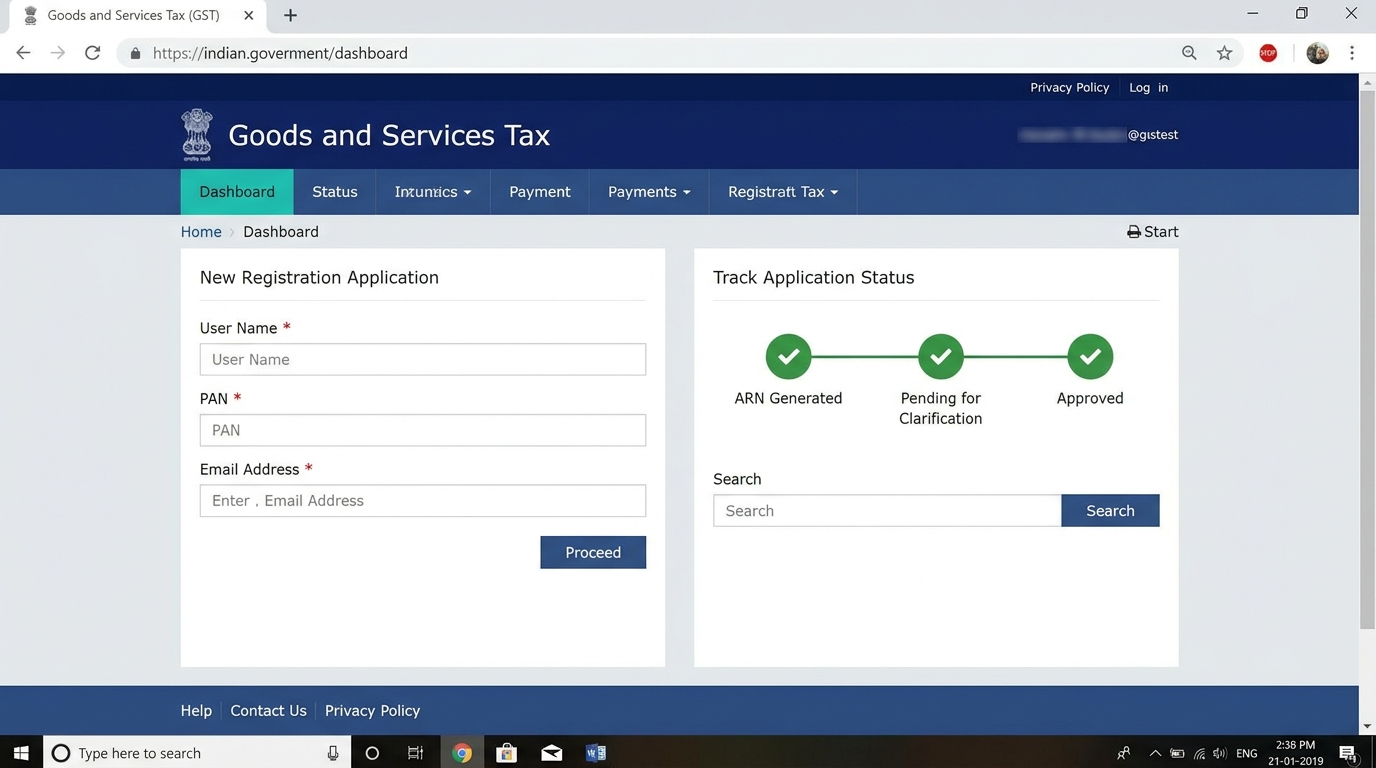
Securing your GSTIN is a completely digital, paperless procedure. Startups apply directly through the official government portal using their Permanent Account Number (PAN), a proof of business constitution (such as a Certificate of Incorporation), and utility bills for address proof.
Once you submit the application with successful Aadhaar authentication, the standard processing time is strictly 7 working days.
 However, registration triggers immediate, recurring obligations. Startups must file regular returns typically GSTR-1 and GSTR-3B on a monthly or quarterly basis under the QRMP scheme. Even if your startup records zero sales in a given month, filing a “Nil Return” is legally mandatory.
Common Mistakes Startups Make with GST
Early-stage founders frequently stumble into compliance traps that lead to heavy fines. Keep an eye out for these frequent operational errors:
- Ignoring RCM liabilities: Many founders mistakenly assume they only pay tax on what they sell. They ignore reverse charge obligations on imported digital tools or domestic legal fees, leading to sudden tax audits.
- Misclassifying export services: Software and SaaS startups often incorrectly charge Integrated GST (IGST) to foreign clients. Instead, they should file a Letter of Undertaking (LUT) to legally process zero-rated exports.
- Failing to file Nil Returns: Assuming that “no sales means no filing” is a critical error. The government levies late fees of 50 per day (20 for nil returns), which quickly compounds up to a maximum cap of 5,000 per return.
Frequently Asked Questions
Is GST mandatory for a startup with less than 20 lakh turnover? No, GST is not mandatory for service startups earning less than 20 lakhs or goods suppliers earning under 40 lakhs annually. However, you must register if you engage in inter-state goods supply or sell on e-commerce platforms, regardless of your total turnover limit.
Do I need GST if I sell on Amazon India ? Yes, you must register for GST to sell goods on platforms like Amazon India or Flipkart. GST requires that all e-commerce marketplace sellers need to be registered under GST before sale, even if their annual turnover is Nil at launch.
What happens if I don’t register for GST when required? Failing to register when legally required triggers severe penalties. The tax department can charge full tax, interest and levy a penalty upto 100% of the tax due. Additionally, they may confiscate your inventory.
Should a new startup register for GST immediately? You should register immediately if you plan to sell on e-commerce platforms, engage in inter-state goods trade, or heavily target B2B enterprise clients. Otherwise, bootstrapping founders often delay registration until approaching the 20 lakh threshold to minimize initial monthly compliance costs.
Can I get ITC without GST registration? No, you cannot claim Input Tax Credit (ITC) without an active GST registration. Unregistered startups must absorb the GST paid on business expenses - like laptops, office rent, and SaaS subscriptions - as a sunk operational cost. Obtaining a GSTIN is the only legal way to avail Input Tax Credit (ITC).
Conclusion
Determining whether is GST required for startups in India comes down to tracking three specific metrics: your overall turnover (crossing the 20L or 40L mark), your sales channel (e-commerce versus direct), and your customer location (inter-state vs. intra-state). While bootstrapped founders can legally delay registration to save on compliance costs, registering voluntarily is often the smarter move to secure Input Tax Credits and win lucrative B2B contracts.
If your startup is approaching these thresholds limit or you want to unlock the strategic benefits of early registration, explore professional compliance support.