
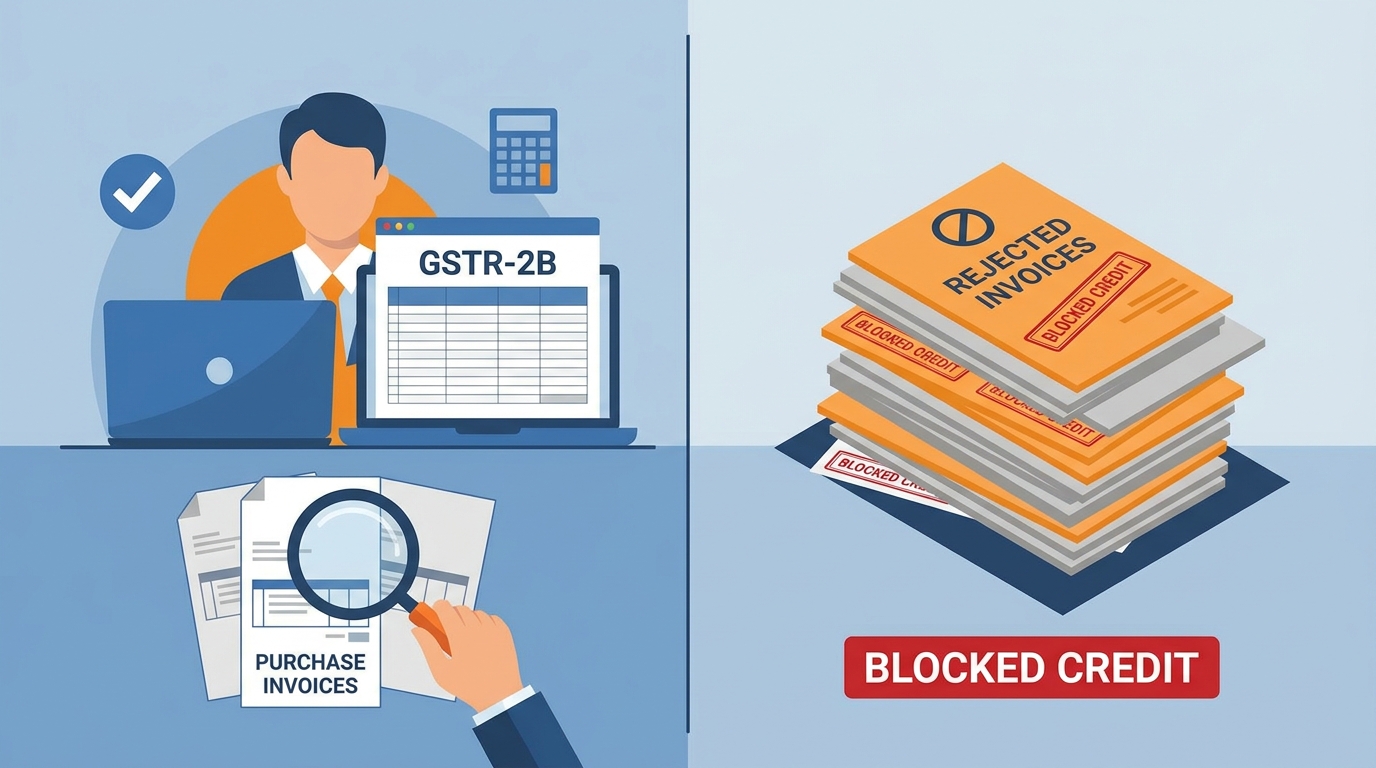
TL;DR: Input Tax Credit lets you offset GST paid on purchases against GST collected on sales, but only if your supplier has filed GSTR-1, you hold a valid invoice, and the purchase is for business use. Most SMEs lose money either by missing eligible ITC or claiming blocked credits like food, club memberships, and personal vehicles. Monthly GSTR-2B reconciliation is the single habit that prevents both mistakes.
Every month, thousands of small businesses in India either overpay GST because they forgot to claim credit they were owed, or get hit with interest and penalty notices because they claimed credit they were never entitled to. Both mistakes come from the same root cause: not understanding how Input Tax Credit actually works in practice.
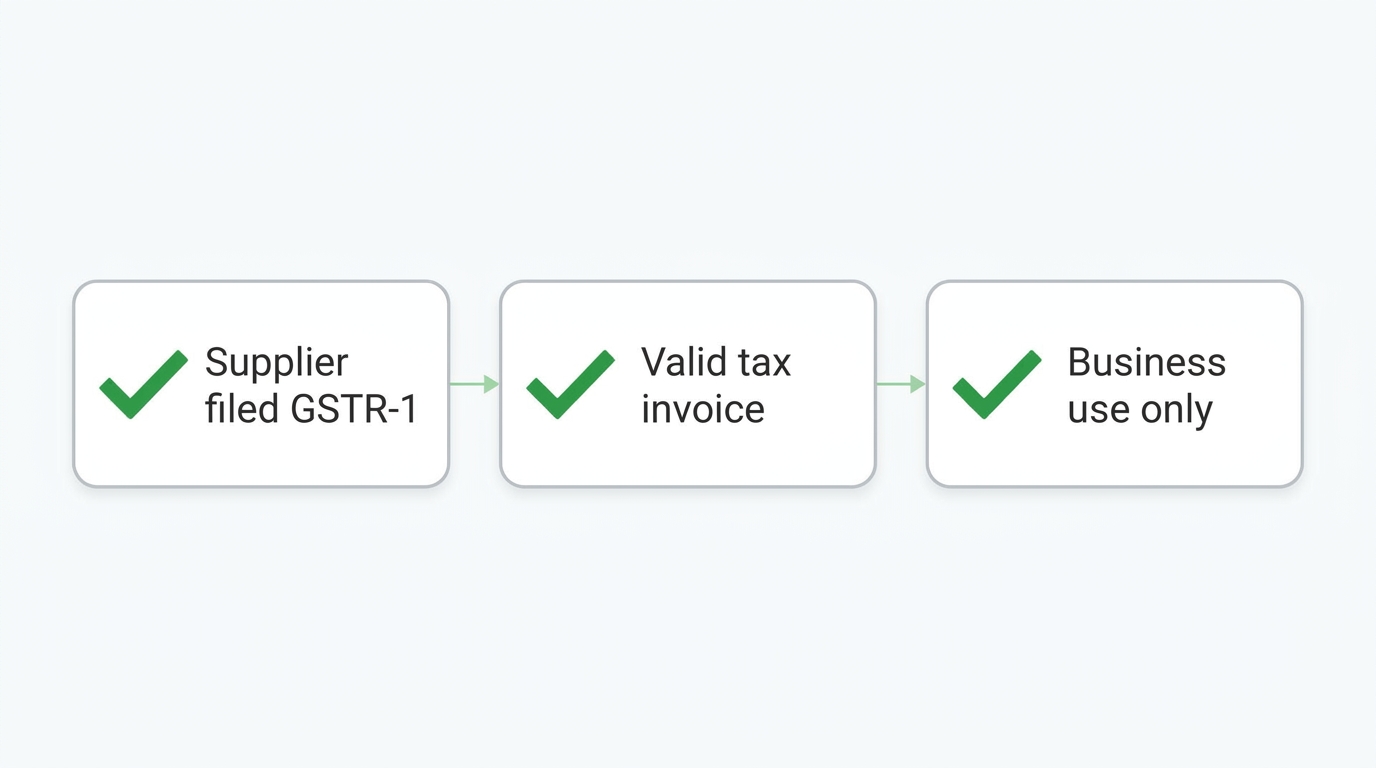
Input Tax Credit (ITC) allows businesses to offset GST paid on purchases against GST collected on sales. These conditions must be met for a valid claim: your supplier has filed GSTR-1, you hold a valid tax invoice, and the goods or services are used for business purposes. Miss any one of these, and your claim can be reversed with interest later, even if you filed your return on time.
This guide is for SME owners, accountants, and finance staff who handle GST filing directly and want a practical, mistake-focused approach to claiming ITC correctly. We will skip the textbook theory and focus on where businesses actually go wrong.
What Is Input Tax Credit (ITC)?
Input Tax Credit is the GST paid on business purchases (inputs) that a registered taxpayer can deduct from the GST collected on sales (output). It prevents the same value from being taxed twice as goods move through the supply chain. For example, if you pay GST of ₹18,000 on raw materials and collect GST of ₹30,000 on sales, you only need to deposit ₹12,000 with the government, provided the ITC is valid.
Why ITC Management Matters for SMEs
For most small businesses, ITC is not a minor accounting detail. It directly affects working capital and cash flow every single month.
Key insight: Businesses that fail to reconcile ITC monthly often discover 15-20% of their eligible credit is either unclaimed or wrongly claimed by the time of annual filing, based on common patterns reported by GST practitioners.
Unclaimed ITC means you are paying more GST in cash than you need to. Wrongly claimed ITC means you owe that amount back with interest at 18% per annum, plus possible penalty if it is flagged during scrutiny. Getting this right monthly, instead of fixing it during annual reconciliation, saves both cash and stress.
The 3 Eligibility Conditions for Claiming ITC
Under Section 16 of the CGST Act, you can claim ITC only when all three conditions below are satisfied together. Missing even one makes the entire claim invalid.
Condition 1: Supplier Has Filed GSTR-1
Your supplier must have reported the invoice in their GSTR-1 return, and it must reflect in your GSTR-2B statement. This is the most common reason SMEs lose ITC that they are technically entitled to.
Example: You buy office supplies worth ₹50,000 plus ₹9,000 GST in March. If your supplier delays filing their GSTR-1 for that month, the invoice will not appear in your GSTR-2B, and you cannot claim that ₹9,000 in March. You must wait until the supplier files, then claim it in the month it appears.
Pro Tip: Keep a running list of suppliers who consistently file late. Follow up with them before the 11th of each month, since that is when GSTR-1 filing is due.
Condition 2: Valid Tax Invoice With Mandatory Fields
You need a proper tax invoice, not just a bill or a delivery challan. A valid invoice under GST rules must include the supplier’s GSTIN, invoice number and date, a description of goods or services, the taxable value, the GST rate and amount charged, and your GSTIN as the recipient.
Example: A vendor sends you an invoice missing their GSTIN or with an incorrect invoice number format. Even if the tax was paid and appears in your books, the credit can be denied during an audit if the invoice does not meet these requirements. Always ask suppliers to correct invoice errors before the return period closes.
Condition 3: Goods or Services Used for Business Purposes
The purchase must be for business use, not personal consumption. This condition is where subjective judgment often creates disputes, especially for mixed-use expenses like mobile phones, vehicles, or utilities.
Example: If you buy a laptop used only in your office for business operations, the ITC is valid. If the same laptop is taken home and used partly for personal browsing, tax officers can question the claim, though in practice, predominant business use is usually accepted for common items like phones and laptops.
Blocked Credits: What You Cannot Claim ITC On
Section 17(5) of the CGST Act lists specific categories where ITC is blocked, regardless of whether the three conditions above are met. SMEs frequently claim these by mistake, leading to reversal notices later.
| Blocked Category | Common SME Mistake |
|---|---|
| Food and beverages | Claiming ITC on staff lunches or client meals |
| Club memberships and gym fees | Claiming ITC on employee wellness perks |
| Personal use vehicles (cars, two-wheelers, vehicles under 13 seats) | Claiming ITC on a car bought for the owner’s personal use |
| Construction of immovable property | Claiming ITC on office building construction |
| Goods lost, stolen, or written off | Claiming ITC on damaged inventory written off in books |
| Rent-a-cab, life insurance, health insurance (unless mandated by law) | Claiming ITC on employee health insurance premiums |
A few of these have exceptions. For instance, ITC on vehicles is allowed if the vehicle is used for transporting goods, for further supply of such vehicles, or for driving training. Similarly, ITC on food and beverages is allowed if it is used for making further supply.
Pro Tip: Before claiming ITC on any large one-time purchase like a vehicle or office renovation, check Section 17(5) exceptions specifically. A wrong claim here is one of the most common reasons for GST department notices to SMEs.
GSTR-2B Reconciliation: The Monthly Process That Saves You Money
GSTR-2B is an auto-generated, static statement that shows all invoices your suppliers have reported for a given tax period. It is the single source of truth for what ITC you are legally allowed to claim. If an invoice does not appear in your GSTR-2B, you cannot claim ITC on it that month, even if you have a valid invoice and made the payment.
Here is the practical reconciliation process SMEs should follow every month:
- Download GSTR-2B from the GST portal on or after the 14th of each month, once it is generated for the previous period.
- Export your purchase register from your accounting software for the same period.
- Match invoice-wise, comparing GSTIN, invoice number, invoice date, and tax amount between your purchase register and GSTR-2B.
- Flag mismatches, including invoices in your books but missing from GSTR-2B, and invoices in GSTR-2B that you have not recorded.
- Follow up with suppliers whose invoices are missing, since this usually means they have not filed GSTR-1 or reported the invoice incorrectly.
- Claim only matched ITC in your GSTR-3B for that month, and carry forward unmatched amounts until the supplier corrects the filing.
Key insight: Since GSTR-2B is a static statement generated once per month, any late supplier filing shows up only in the next month’s GSTR-2B, not the current one. This is why real-time reconciliation, not a once-a-year check, is critical.
ITC Reversal Triggers: When You Must Pay Back Claimed Credit
Even after correctly claiming ITC, certain situations require you to reverse it, meaning you add it back to your GST liability along with interest. SMEs commonly miss these triggers until an audit catches them.
- Goods or services not actually received: If you claimed ITC on an invoice but the goods were never delivered or the service was never performed, the credit must be reversed immediately.
- Invoice cancelled by the supplier: If your supplier later cancels or amends the invoice, any ITC claimed against it needs to be reversed in that period.
- Mixed personal and business use: For expenses used partly for personal purposes, like a shared vehicle or utility connection, you must reverse the proportionate ITC attributable to personal use.
- Payment not made within 180 days: Under GST rules, if you do not pay your supplier within 180 days from the invoice date, the ITC claimed must be reversed, added back with interest, and can be reclaimed only once payment is made.
Pro Tip: Set a calendar reminder at 150 days from invoice date for large unpaid supplier bills. This gives you a 30-day buffer to clear the payment before you are forced to reverse the ITC.
Common Mistakes SMEs Make With ITC
- Claiming ITC before checking GSTR-2B, based only on the invoice received, which leads to mismatches and reversal notices later.
- Ignoring the 180-day payment rule, especially with related-party or long-credit-cycle vendors.
- Claiming ITC on blocked categories like employee food, club memberships, or personal vehicles, often due to unclear accounting classification.
- Not following up with non-filing suppliers, resulting in permanently lost ITC if the supplier never files.
- Skipping monthly reconciliation and only checking ITC once a year during annual return filing, by which time correction options are limited.
Frequently Asked Questions
Can I claim ITC if my supplier hasn’t filed GSTR-1? No, you cannot claim ITC until the invoice appears in your GSTR-2B, which depends on your supplier filing GSTR-1. Once they file it, even late, the invoice reflects in your next GSTR-2B, and you can claim it in that period.
What is blocked input tax credit in GST? Blocked credit refers to specific purchase categories under Section 17(5) where ITC cannot be claimed even if all other conditions are met. This includes food and beverages, club memberships, personal vehicles, and construction of immovable property, with limited exceptions for business-specific use cases.
How do I reconcile ITC with GSTR-2B? Download your GSTR-2B monthly and match it invoice-by-invoice against your purchase register using GSTIN, invoice number, and tax amount. Claim ITC only for matched invoices, and follow up with suppliers for any missing entries before your GSTR-3B filing deadline.
Can I claim ITC on a business vehicle purchase? Generally no, ITC on cars and vehicles with seating capacity under 13 is blocked, even for business use. Exceptions apply if the vehicle is used for transporting goods, further supply of vehicles, or driving training services.
What happens if I claim excess ITC? Excess ITC claimed must be reversed along with interest at 18% per annum from the date of claim until reversal. If detected during a department audit rather than self-corrected, it can also attract penalty under GST rules.
Conclusion
Getting Input Tax Credit right comes down to three habits: verifying the three eligibility conditions before claiming, knowing which categories are permanently blocked under Section 17(5), and reconciling your purchase register against GSTR-2B every single month. SMEs that build this monthly discipline avoid both the cash flow drag of missed ITC and the penalty risk of wrongly claimed credit.
If you are still reconciling ITC manually at year-end, start by pulling last month’s GSTR-2B today and matching it against your purchase register. That one habit, repeated monthly, is what separates businesses that manage GST smoothly from those that get blindsided by notices later.