

TL;DR: Every GST-registered business must file GSTR-1 by the 11th and GSTR-3B by the 20th of each month. Missing these deadlines triggers late fees of ₹50 per day (₹20 for NIL returns) and an 18% annual interest charge on unpaid tax. Use our actionable checklists below to reconcile invoices, match Input Tax Credit (ITC) with GSTR-2B, and ensure 100% filing accuracy.
What Is the Monthly GST Return Filing Process?
The monthly GST return filing process is a mandatory compliance routine for active GST-registered businesses in India. It involves reporting all outward supplies (sales) in form GSTR-1 by the 11th of the following month, and filing a summary return with tax payment in form GSTR-3B by the 20th.
Why Strict Monthly GST Reconciliation Matters
Navigating the Goods and Services Tax (GST) landscape can feel like walking a tightrope. One missed invoice or mismatched Input Tax Credit (ITC) can lead to hefty penalties, delayed working capital, and department notices. For business owners and accountants, maintaining a strict, systematic monthly routine is the key to stress-free compliance.
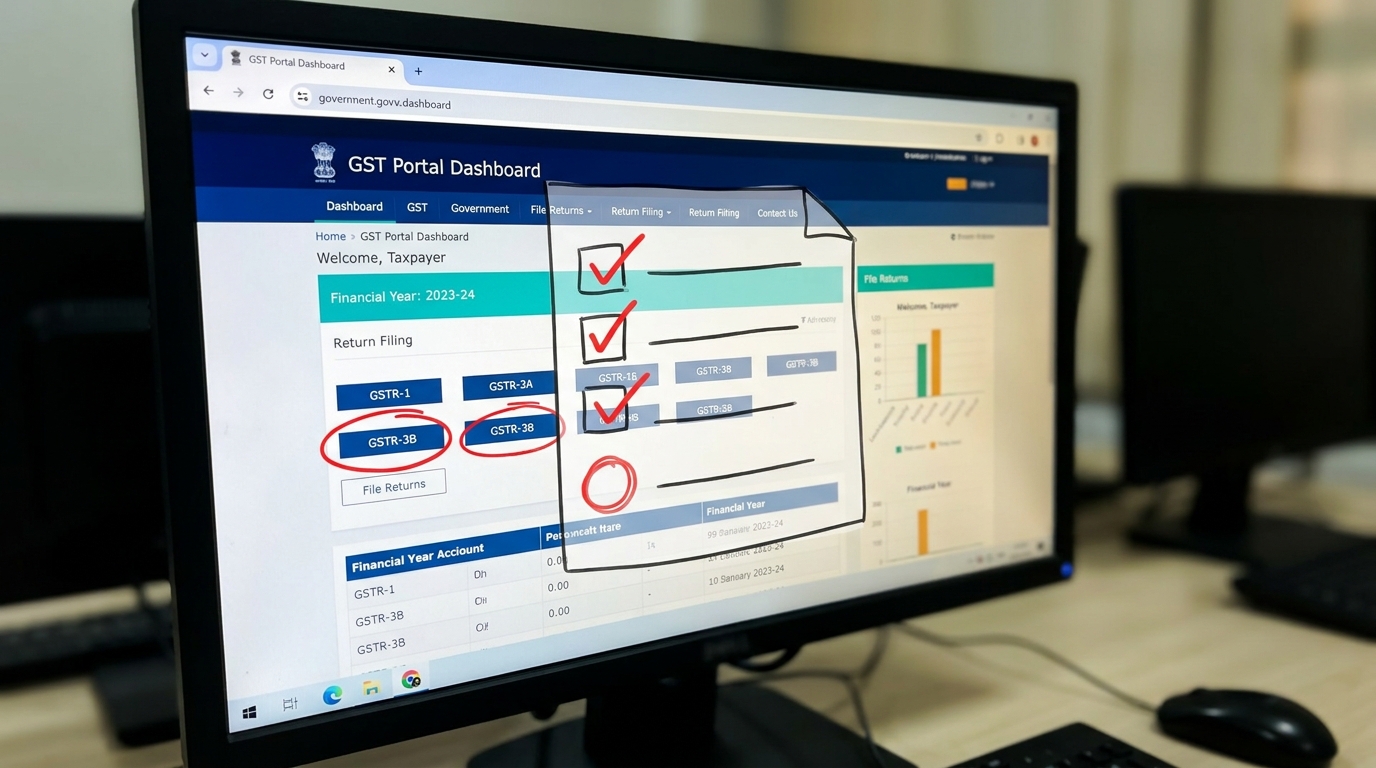
This actionable monthly GST return filing checklist for businesses is designed specifically for finance teams and entrepreneurs who want an exact, repeatable process to print and execute.
Failing to adhere to the strict timelines established by the Central Board of Indirect Taxes and Customs (CBIC) results in immediate financial consequences. Section 47 of the CGST Act mandates strict late fees, while Section 50 enforces interest on delayed payments.
Key insight: Missing your GSTR-3B deadline incurs a late fee of ₹50 per day (₹25 CGST + ₹25 SGST), or ₹20 per day for NIL returns. Additionally, a strict 18% per annum interest rate applies to the net unpaid tax liability.
Beyond direct financial penalties, delayed filings prevent your buyers from claiming their eligible ITC. If your invoices do not appear in their GSTR-2B, they will likely delay your payments, severely impacting your business’s cash flow and reputation.
Pre-GSTR-1 Monthly GST Return Filing Checklist
GSTR-1 is your statement of outward supplies. You must file this by the 11th of the succeeding month so your customers can claim their ITC on time. Print this checklist and verify each item before hitting submit on the GST Portal.
Outward Supplies Verification
- [ ] Capture all sales invoices: Ensure every sales invoice generated during the month is recorded in the accounting system.
- [ ] Verify sequential numbering: Check that all tax invoices follow a consecutive sequence without missing numbers.
- [ ] Separate B2B and B2C sales: Accurately categorize sales to registered businesses (B2B) and unregistered consumers (B2C).
- [ ] Validate GSTINs: Verify that all B2B customer GST Identification Numbers (GSTIN) are active and accurately entered.
Special Transactions and Details
- [ ] Reconcile credit and debit notes: Ensure all credit notes (sales returns) and debit notes are properly linked to their original invoices.
- [ ] Verify HSN/SAC codes: Check that Harmonized System of Nomenclature (HSN) and Service Accounting Codes (SAC) match the mandatory digit requirements based on your aggregate turnover.
- [ ] Mark export invoices correctly: Classify export invoices accurately as “With Payment of Tax” or “Without Payment of Tax” (Letter of Undertaking).
- [ ] Identify exempt and nil-rated sales: Separate and accurately report non-GST, exempt, and nil-rated supplies.
Pre-GSTR-3B Monthly Checklist
GSTR-3B is your monthly summary return where you declare your total tax liability, claim ITC, and pay the net tax due. This must be filed by the 20th of the succeeding month.
Input Tax Credit (ITC) Reconciliation
- [ ] Download GSTR-2B: Pull the auto-drafted ITC statement (GSTR-2B) from the GST portal on the 14th of the month.
- [ ] Match purchase register with GSTR-2B: Reconcile your internal purchase invoices against GSTR-2B. You can only claim ITC that reflects in GSTR-2B.
- [ ] Identify ineligible ITC: Filter out blocked credits under Section 17(5) (e.g., food, beverages, motor vehicles) and reverse them accordingly.
- [ ] Track pending ITC: Flag invoices missing from GSTR-2B and follow up with the respective vendors to upload their GSTR-1.
Tax Liability and Payment
- [ ] Cross-check GSTR-1 vs. 3B liability: Ensure the outward tax liability in GSTR-3B perfectly matches the data submitted in GSTR-1.
- [ ] Identify Reverse Charge Mechanism (RCM): Calculate tax liability on services/goods subject to RCM (e.g., goods transport agency, legal services) and pay it in cash.
- [ ] Calculate net tax payable: Deduct eligible ITC from your total output tax liability to find your net cash payable.
- [ ] Verify cash ledger balance: Generate a challan and ensure sufficient funds are deposited into the Electronic Cash Ledger before the 20th.
Pro Tip: Always complete your internal GST reconciliation between your books and the portal before the 11th. Waiting until the 18th or 19th leaves no time to resolve discrepancies with vendors.
Post-Filing Actions
Filing the return is not the final step. Completing this administrative wrap-up ensures audit readiness and protects your business from future disputes.
- [ ] Save the ARN confirmation: Document the Application Reference Number (ARN) generated upon successful filing.
- [ ] Download filed PDFs: Save digital copies of the filed GSTR-1 and GSTR-3B directly to your local cloud storage for audit trails.
- [ ] Verify GSTR-2A visibility: Spot-check with key clients to ensure your submitted GSTIN and invoice details are successfully reflecting in their GSTR-2A/2B.
- [ ] Update accounting books: Pass the final tax adjustment journal entries in your accounting software to clear the GST liability ledgers.
Understanding the QRMP Scheme
For smaller enterprises, the government introduced the Quarterly Return Filing and Monthly Payment of Taxes (QRMP) scheme to ease the compliance burden.
If your business has an aggregate annual turnover of less than ₹5 Crore, you can opt into this scheme. Under QRMP, you file GSTR-1 and GSTR-3B once every quarter rather than monthly.
However, tax payments remain a monthly obligation. You must pay your estimated monthly tax liability via Form PMT-06 by the 25th of the following month. Additionally, you can use the Invoice Furnishing Facility (IFF) to upload essential B2B invoices monthly (up to ₹50 Lakhs), ensuring your buyers still receive their ITC on time without waiting for your quarterly return.
Common GST Filing Mistakes to Avoid
Even with a checklist, specific manual errors frequently trigger automated scrutiny notices from the tax department. Watch out for these operational pitfalls:
- GSTR-1 and GSTR-3B Mismatch: Declaring ₹1,00,000 tax in GSTR-1 but only ₹80,000 in GSTR-3B will immediately trigger a Form ASMT-10 notice for underpayment of taxes.
- Ignoring Reverse Charge Liability: Many accountants forget to account for RCM on freight and legal expenses. RCM must be paid in cash first; only then can you claim it as ITC in the same month.
- Claiming Provisional ITC: Since January 2022, the 5% provisional ITC rule is abolished. Claiming any ITC that does not strictly appear in your GSTR-2B is illegal and will incur 18% interest.
Frequently Asked Questions
What is the due date for GSTR-1 filing?
The due date for filing GSTR-1 is the 11th of the subsequent month for normal taxpayers. If you are enrolled in the QRMP scheme, you can use the Invoice Furnishing Facility (IFF) to upload B2B invoices by the 13th of every month to pass on ITC.
What is the penalty for late GSTR-3B filing?
The penalty for late GSTR-3B filing is a late fee of ₹50 per day (₹25 CGST and ₹25 SGST). For a NIL return, the fee is reduced to ₹20 per day. Additionally, an 18% annual interest is charged on the outstanding tax amount from the due date.
What is the QRMP scheme in GST?
The Quarterly Return Filing and Monthly Payment of Taxes (QRMP) scheme allows businesses with an annual aggregate turnover of up to ₹5 Crore to file GST returns quarterly. However, taxpayers must still pay their estimated tax liability on a monthly basis using a simple challan.
How do I file a NIL GSTR-1?
You can file a NIL GSTR-1 if you have no outward supplies or sales during the month. To file, log into the GST portal, select the relevant return period, and submit the NIL return via SMS (using the designated mobile number) or through the online dashboard.
What happens if GSTR-1 and GSTR-3B don’t match?
If your GSTR-1 sales data and GSTR-3B summary do not match, the GST portal will flag the discrepancy. The tax department may issue a notice in Form ASMT-10 demanding an explanation or payment of the differential tax, alongside applicable interest and potential penalties for non-compliance.
Conclusion
Staying compliant with India’s tax laws requires strict discipline, but using a structured monthly GST return filing checklist for businesses transforms a chaotic chore into a manageable system. By meticulously verifying outward supplies for GSTR-1 and strictly reconciling your ITC with GSTR-2B before filing GSTR-3B, you protect your working capital from penalties and preserve strong relationships with your vendors and buyers.