
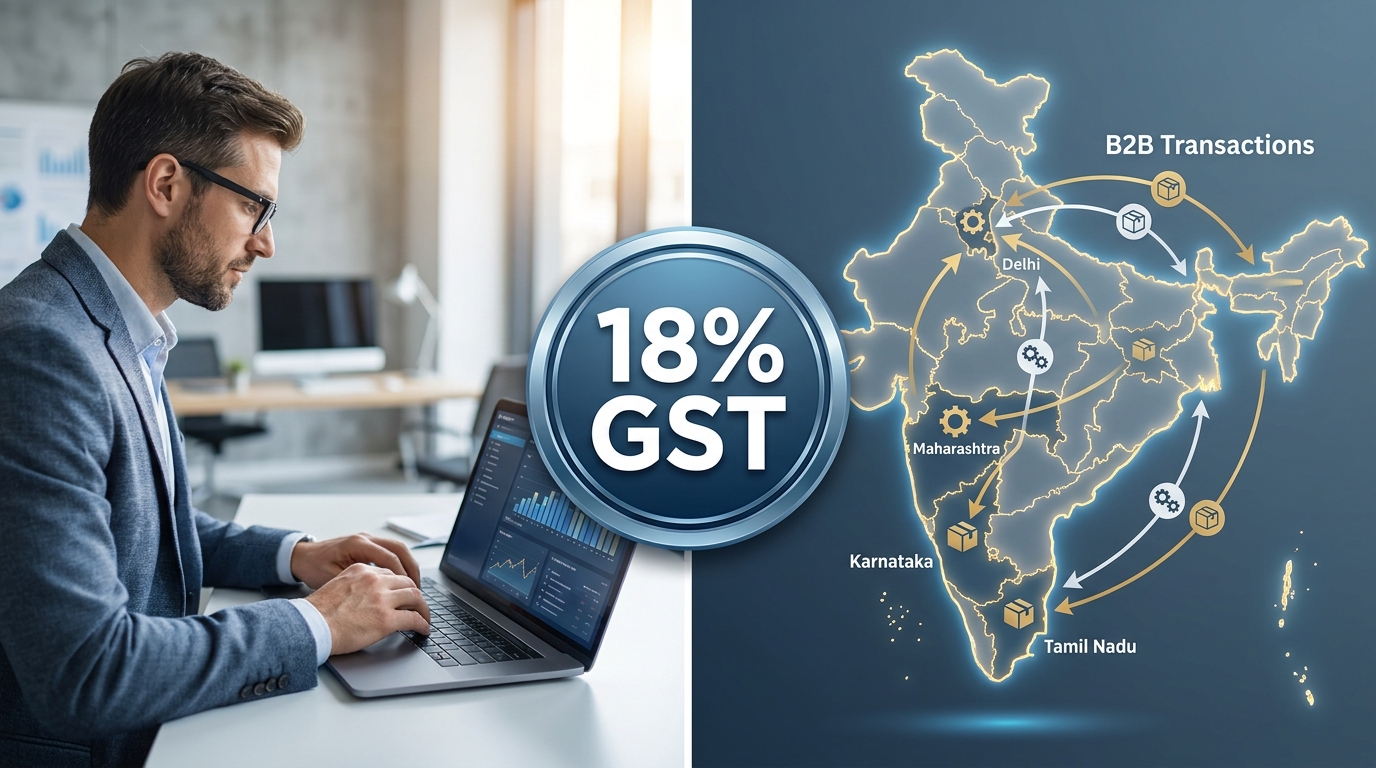
TL;DR: For service businesses, GST is typically charged at a standard rate of 18%, with the critical ‘place of supply’ rule heavily dependent on the recipient’s location. Misclassifying this location can lead to paying taxes in the wrong state and creating complex reconciliation issues. Mastering B2B versus B2C transactions, Reverse Charge Mechanism (RCM), and Input Tax Credit (ITC) is essential for financial compliance.
Introduction
Taxing intangible services is inherently more complex than taxing physical goods. When a software agency in Bengaluru builds an app for a client in Delhi, determining exactly where the transaction occurred dictates which state collects the tax revenue. Understanding GST for service businesses in India is a critical requirement for agencies, consultants, and freelancers who want to avoid costly compliance failures.
For most service providers, GST is charged at an 18% rate, and the recipient’s location determines the “place of supply.” Getting this specific rule wrong means remitting tax to the wrong state jurisdiction, triggering complex reconciliation headaches and potential penalties during audits.
Whether you run a marketing agency, an IT consulting firm, or an online training platform, this guide is designed for Indian service entrepreneurs. We will break down exactly how to determine your tax liabilities, claim proper credits, and streamline your compliance.
What Is GST for Service Businesses in India?
Under the Indian Goods and Services Tax framework, services are classified as taxable supplies of intangible benefits. Service businesses must identify their specific Services Accounting Code (SAC) and apply the correct tax rate, typically 18%, while adhering to strict place of supply rules to determine the correct state jurisdiction for tax remittance.
The Standard 18% Rate and Common Exceptions
The Central Board of Indirect Taxes and Customs (CBIC) classifies services using a system of Services Accounting Codes (SAC) which begins with 99 and is a 6-digit code. Fortunately, you do not need to memorize the entire directory. The vast majority of standard commercial services fall under a flat 18% GST rate.
Here is how GST applies to the most common service categories:
| Service Category | Standard GST Rate | SAC Category Focus | Key Compliance Note |
|---|---|---|---|
| IT & Software Services | 18% | 9983 | Includes SaaS, cloud hosting, and custom software development. |
| Consulting & Professional | 18% | 9983 / 9982 | Covers management consulting, accounting, and legal advisory. |
| Training & Coaching | 18% | 9992 | Applies to private coaching and corporate training programs. |
| Healthcare Services | Exempt (0%) | 9993 | Clinical healthcare is exempt, but cosmetic treatments are taxable. |
| Export of Services | Zero-rated (0%) | N/A | Requires a Letter of Undertaking (LUT) to export without paying IGST. |
Key insight: Service providers must register for GST when their aggregate annual turnover exceeds ₹20 lakhs (₹10 lakhs for special category states), which is lower than the ₹40 lakh threshold granted to goods manufacturers.
If your firm exports services to clients outside India, these transactions are considered “zero-rated.” By filing a Letter of Undertaking (LUT) at the start of the financial year, you can export services without charging GST while still claiming Input Tax Credit on your business expenses.
Determining the Place of Supply (B2B vs. B2C)
The most critical concept in GST for service businesses in India is the “Place of Supply.” Because services are intangible, the government uses specific rules outlined in the Integrated GST (IGST) Act to determine whether a transaction is intrastate (CGST + SGST) or interstate (IGST).
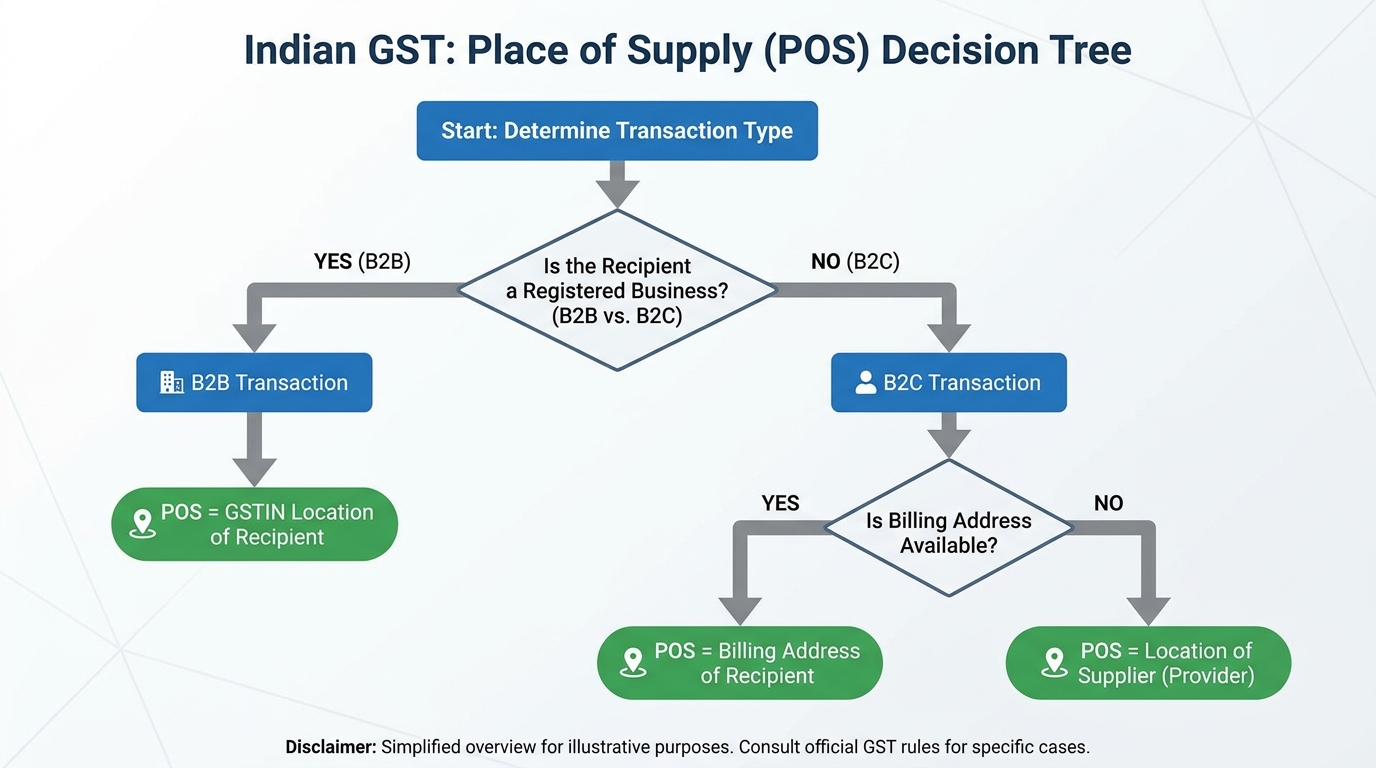
Generally, the place of supply is determined by the recipient’s location.
For B2B Transactions (Business-to-Business):If you provide a service to a GST-registered business, the place of supply is, generally, the location registered to their GSTIN. If your consulting firm is in Maharashtra and your registered client is in Karnataka, you must charge IGST, regardless of where the work was physically performed.
For B2C Transactions (Business-to-Consumer):If your client is unregistered, the place of supply is their billing address on your records. If you do not have their billing address (for example, a walk-in consultation), the place of supply defaults to the location of your own service business.
Understanding the Reverse Charge Mechanism (RCM)
Normally, the service provider collects GST from the client and pays it to the government. Under the Reverse Charge Mechanism (RCM), this responsibility flips: the recipient of the service is legally obligated to calculate and pay the tax directly to the government.
Service businesses frequently encounter RCM in three specific scenarios:
- Imported Services: If you purchase software subscriptions (like AWS or Google Workspace) from a foreign entity, or hire a freelancer outside India, you are importing a service. You must pay 18% IGST under RCM on these expenses.
- Legal Services: Fees paid to advocates or legal firms are subject to RCM.
- Goods Transport Agency (GTA): Freight and transport services often require the business receiving the goods to pay the tax under RCM.
Pro Tip: Tax paid under RCM can typically be claimed back as Input Tax Credit in the same month, making it a cash-flow neutral transaction, but failing to declare it is a major audit red flag.
Claiming Input Tax Credit (ITC) as a Service Provider
One of the massive advantages of the GST regime is the ability to claim Input Tax Credit (ITC) on your operational expenses. This prevents the “cascading effect” of taxes, ensuring you only pay tax on the value you add.
Service businesses can easily claim ITC on:
- Office Rent: GST paid on commercial leasing.
- Software and Subscriptions: Cloud hosting, CRM software, and digital tools used for business.
- Professional Fees: Payments made to Chartered Accountants, marketing agencies, or subcontracted freelancers.
- Advertising Costs: Ad spend on platforms like Google, Facebook, or LinkedIn.
Unlike manufacturers, service businesses generally do not face the complex “blocked ITC” issues associated with heavy capital goods, making monthly reconciliation much smoother. However, to claim ITC, your vendor must file their GSTR-1, and the invoice must reflect in your GSTR-2B.
Common GST Mistakes Service Businesses Make
Even experienced service founders stumble over GST compliance. Avoid these common pitfalls to keep your financial records clean:
- Misclassifying Place of Supply: Charging CGST/SGST instead of IGST because you ignored the client’s registered GSTIN state. This results in paying tax to the wrong state government.
- Ignoring RCM on Foreign SaaS Tools: Failing to pay RCM on international software subscriptions is one of the most common errors caught during GST audits.
- Exporting Without an LUT: If you bill a US client without filing a Letter of Undertaking for the current financial year, you are legally required to pay 18% IGST out of your own pocket and file for a tedious refund later.
- Delayed GSTR-1 Filing: Delaying your outward supply returns prevents your B2B clients from claiming their ITC, severely damaging your business relationships.
Frequently Asked Questions
What is the GST rate for service businesses in India?
Most commercial service businesses in India fall under a standard GST rate of 18%. This applies to IT services, consulting, digital marketing, and professional services. However, specific sectors like healthcare and education are exempt, while exported services are zero-rated.
What is the place of supply for service businesses?
The place of supply determines which state collects the tax. For B2B transactions, it is the location registered to the client’s GSTIN. For B2C transactions, it is the client’s billing address, or the service provider’s location if the billing address is unverified.
Can service businesses claim input tax credit?
Yes, service businesses can claim input tax credit (ITC) on goods and services used for their business operations. Common eligible expenses include commercial office rent, software subscriptions, advertising costs, and professional fees paid to other registered vendors.
Is GST applicable on services exported from India?
Services exported out of India are considered “zero-rated” supplies. This means the GST rate is 0%. However, to legally export without paying IGST, the service provider must actively file a Letter of Undertaking (LUT) on the GST portal annually.
What is the reverse charge mechanism for services?
Under the Reverse Charge Mechanism (RCM), the buyer (recipient) of the service is liable to pay the GST directly to the government instead of the service provider. For service businesses, this most commonly applies to imported digital services and legal fees.
Conclusion
Mastering GST for service businesses in India is not just about filing monthly returns; it is about protecting your margins and preventing costly jurisdictional errors. By understanding the critical distinction between B2B and B2C place of supply, leveraging zero-rated exports with an LUT, and correctly applying the reverse charge mechanism on your software imports, you can streamline your operations significantly.
Compliance does not have to be a bottleneck for your agency’s growth. Take a proactive step today by auditing your current invoicing templates to ensure your place of supply rules align with the standard 18% rate regulations.