
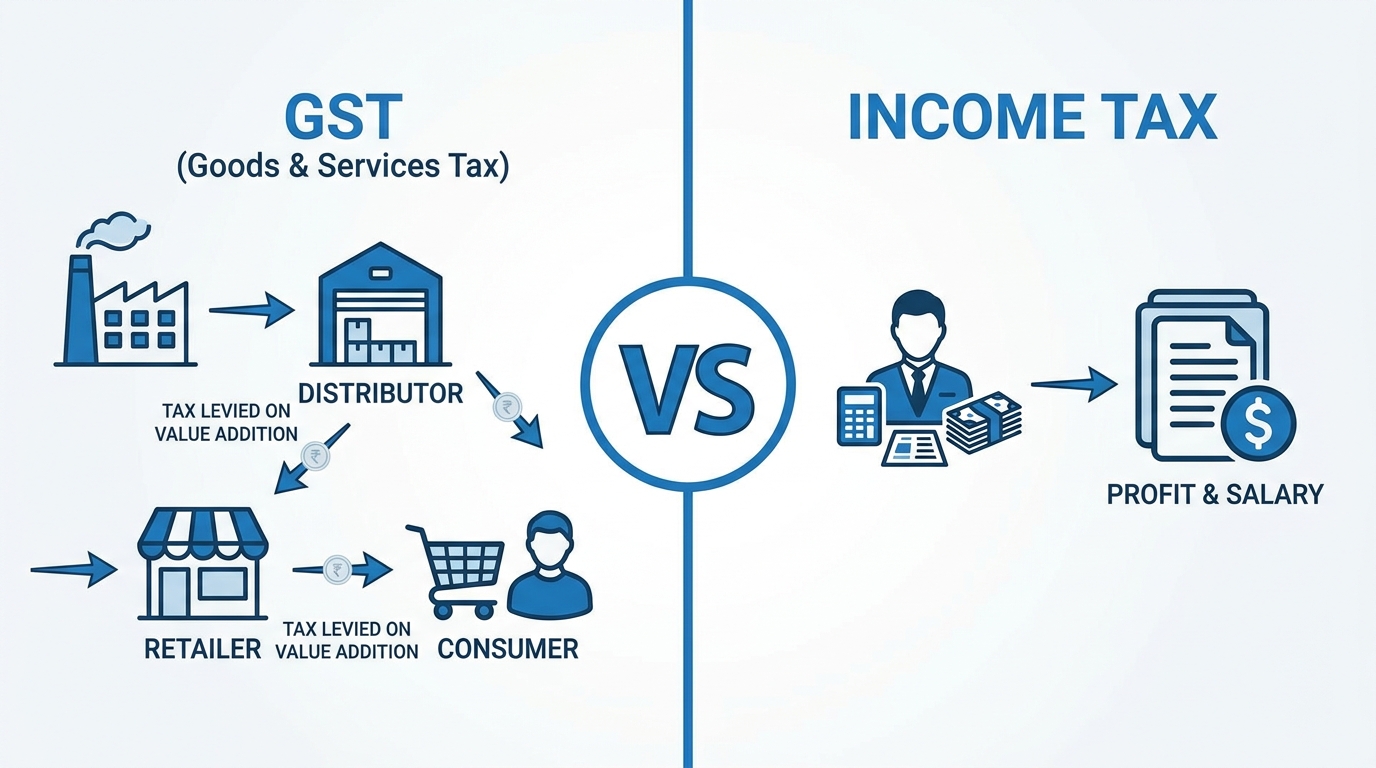
TL;DR: GST is an indirect tax charged on the supply of goods and services at every stage of the supply chain, while income tax is a direct tax on the profit or income earned by a person or business. Every business in India must comply with both, and paying one does not reduce or replace the obligation to pay the other. This guide compares both taxes side by side across 8 key dimensions and ends with a decision table to help you quickly identify which tax law applies to your question.
Introduction
Confusing GST and income tax is one of the most common mistakes new business owners make in India. GST is an indirect tax on the supply of goods and services, collected at each stage of the supply chain. Income tax is a direct tax on the profit earned by individuals and businesses. A business in India must comply with both, and they are completely independent obligations governed by different laws, different departments, and different deadlines.
This comparison is written for small business owners, freelancers, and startup founders who need a clear side-by-side view instead of two separate tax lectures. If you have ever wondered why your accountant asks you to file two completely different sets of returns, this article explains exactly where GST and income tax overlap and where they don’t.
GST vs Income Tax: The Core Difference
GST taxes the transaction, income tax taxes the profit. GST is charged every time you sell a product or service, regardless of whether your business made money that year. Income tax, on the other hand, is calculated only on your net income after expenses, and it doesn’t care how many transactions you completed.
Key insight: A business can pay lakhs in GST during a loss-making year because GST is charged on turnover and sales, not on profit.
This single distinction explains almost every other difference between the two taxes, including how they are filed, who regulates them, and how penalties are structured.
GST vs Income Tax: 8-Dimension Comparison Table
| Dimension | GST | Income Tax |
|---|---|---|
| What it taxes | Supply of goods and services (transaction value) | Net profit or total income earned |
| Administered by | Central Board of Indirect Taxes and Customs (CBIC) | Central Board of Direct Taxes (CBDT) |
| Applicable threshold | Registration required above Rs 40 lakh turnover for goods, Rs 20 lakh for services (varies by state) | Filing required if income exceeds the basic exemption limit (Rs 2.5 lakh to Rs 3 lakh depending on regime) |
| Filing frequency | Monthly or quarterly (GSTR-1, GSTR-3B), plus annual return | Annual, with quarterly advance tax payments |
| Governing act | Central Goods and Services Tax Act, 2017 | Income Tax Act, 1961 |
| Penalty structure | Late fee per day of delay plus interest on unpaid tax | Interest under Sections 234A/B/C plus penalty for concealment or non-filing |
| ITC/deductions | Input Tax Credit (ITC) on GST paid for business purchases | Business expense deductions, depreciation, Section 80C to 80U deductions |
| Key return forms | GSTR-1, GSTR-3B, GSTR-9 | ITR-3, ITR-4, ITR-6 (depending on business structure) |
GST vs Income Tax: Who Administers Each One
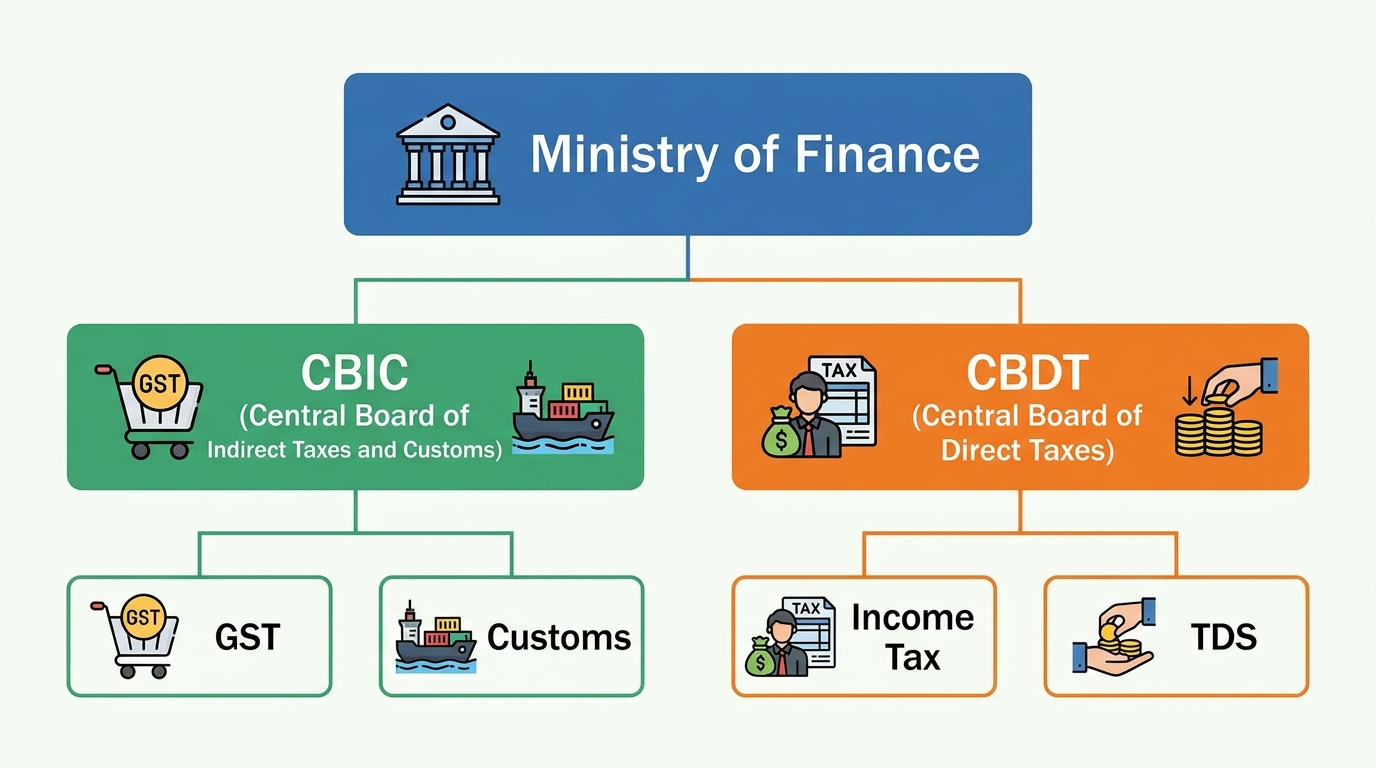
GST falls under the CBIC, which operates under the Ministry of Finance and handles registration, audits, and refunds for indirect taxes. Income tax falls under the CBDT, a completely separate wing of the same ministry that handles assessments, refunds, and scrutiny for direct taxes. These two boards do not share filing systems, so a clean GST record does not automatically mean a clean income tax record, and vice versa.
GST vs Income Tax: Filing Frequency and Deadlines
GST demands far more frequent attention than income tax. Most businesses file GSTR-1 and GSTR-3B every month or quarter, on top of an annual return (GSTR-9). Income tax, by contrast, is filed once a year, though larger businesses and professionals must pay advance tax in four installments throughout the year.
Pro Tip: Set separate calendar reminders for GST and income tax deadlines. Many businesses miss GST filings because they mentally lump all “tax work” into one annual task around income tax season.
GST vs Income Tax: Penalty Structures Compared
GST penalties are transaction-focused. A late GSTR-3B filing attracts a late fee for every day of delay, plus interest at 18% per annum on the unpaid tax amount. Income tax penalties are assessment-focused. Missing the filing deadline triggers interest under Section 234A, and under-reporting income can lead to penalties of 50% to 200% of the tax evaded under Section 270A.
Both systems charge interest for delay, but GST penalties accumulate daily and can escalate quickly for high-turnover businesses, while income tax penalties are usually assessed once a year during scrutiny.
GST vs Income Tax: ITC vs Deductions
Input Tax Credit (ITC) under GST lets a business offset the GST it already paid on purchases against the GST it collects on sales. Deductions under income tax work differently. They reduce your taxable income itself, through business expenses, depreciation, or deductions under sections like 80C and 80D.
These two mechanisms are not interchangeable. GST paid on office supplies can be claimed as ITC against your GST liability, but that same amount can also be recorded as a business expense that reduces your taxable profit for income tax purposes. Both benefits apply to the same purchase, but through two entirely separate calculations.
Common Confusion 1: “I Pay GST, So I Don’t Need to Worry About Income Tax”
This is wrong, and it’s one of the most expensive misunderstandings a business owner can carry. GST and income tax are independent obligations under different acts, and paying one has zero bearing on your liability for the other. A shop owner who diligently files GST every month but skips income tax filing is still fully liable for income tax, interest, and penalties on unreported profit.
Registering for GST does not exempt you from filing an income tax return, and having a clean GST record will not protect you during an income tax scrutiny assessment. Treat them as two completely separate compliance calendars.
Common Confusion 2: GST on Services vs TDS
Many business owners get confused when both GST and TDS (Tax Deducted at Source) apply to the same invoice. GST is charged by the service provider on the value of the service supplied. TDS, which is part of income tax law, is deducted by the person making the payment, as an advance collection of the recipient’s income tax liability.
For example, if a consultant raises an invoice of Rs 1,00,000 plus 18% GST, the client may deduct TDS at 10% on the base amount under Section 194J of the Income Tax Act, while still paying the full GST amount to the consultant. Both deductions happen on the same transaction, but they belong to completely different tax systems and get reported in separate returns.
Key insight: TDS deducted appears in Form 26AS and is adjusted against income tax liability, not GST liability. GST paid is claimed separately through ITC.
Common Mistakes Business Owners Make
- Assuming one filing covers both — GST returns and income tax returns are filed on entirely different portals with different formats.
- Missing GST deadlines while focused on income tax season — GST requires monthly or quarterly attention, not just once a year.
- Confusing TDS with GST deduction — TDS reduces income tax liability, GST is a separate output tax.
- Not maintaining separate records — invoices need to track both GST charged and income for tax purposes, and mixing the two makes audits harder.
- Believing GST registration threshold equals income tax filing threshold — these thresholds are set independently and don’t align.
Decision Table: Which Tax Law Applies to Your Question
Use this table to instantly identify whether your question falls under GST or income tax.
If your question is about…It’s governed by…Charging tax on an invoice for goods or servicesGSTCalculating your total taxable profit for the yearIncome TaxClaiming credit for tax paid on business purchasesGST (Input Tax Credit)Claiming deductions for business expenses or investmentsIncome TaxMonthly or quarterly return filingGSTAnnual return filingIncome TaxDeduction at source when making a payment to a vendorIncome Tax (TDS)Tax on export or import of goodsGSTAdvance tax installmentsIncome TaxRegistration threshold for a new businessGSTPenalty for late filing of returnsBoth, but calculated differentlyAudit of your books above a turnover limitBoth, under separate audit rules
Frequently Asked Questions
What is the difference between GST and income tax? GST is an indirect tax charged on the supply of goods and services, collected at every stage of the supply chain. Income tax is a direct tax on the net profit or income earned by an individual or business. GST is transaction-based, while income tax is profit-based, and they are governed by separate laws entirely.
Do I pay both GST and income tax? Yes, most businesses must comply with both if they exceed the respective thresholds. GST applies once your turnover crosses the registration limit, while income tax applies once your income crosses the basic exemption limit. Paying one does not exempt you from the other.
Which is more important for a small business — GST or income tax? Neither is more important; both are mandatory once you cross their respective thresholds. GST requires more frequent attention due to monthly or quarterly filings, while income tax carries heavier penalties for concealment. Ignoring either one creates real financial and legal risk.
Can GST paid be deducted from income tax? GST paid on business purchases is claimed as Input Tax Credit against your GST liability, not against income tax. However, the cost of goods or services (excluding the ITC portion) can be recorded as a business expense, which reduces your taxable profit for income tax purposes.
Conclusion
GST and income tax serve completely different purposes even though both fall under India’s tax system. GST taxes the supply of goods and services at every stage of the chain, while income tax taxes the profit a business or individual actually earns. Understanding GST vs income tax as two independent obligations, rather than one combined “tax filing” task, is what keeps a business compliant and penalty-free on both fronts.
Use the decision table above whenever you’re unsure which law applies to your question, and if your filings feel overdue on either side, get a compliance review before the next deadline hits rather than after.