
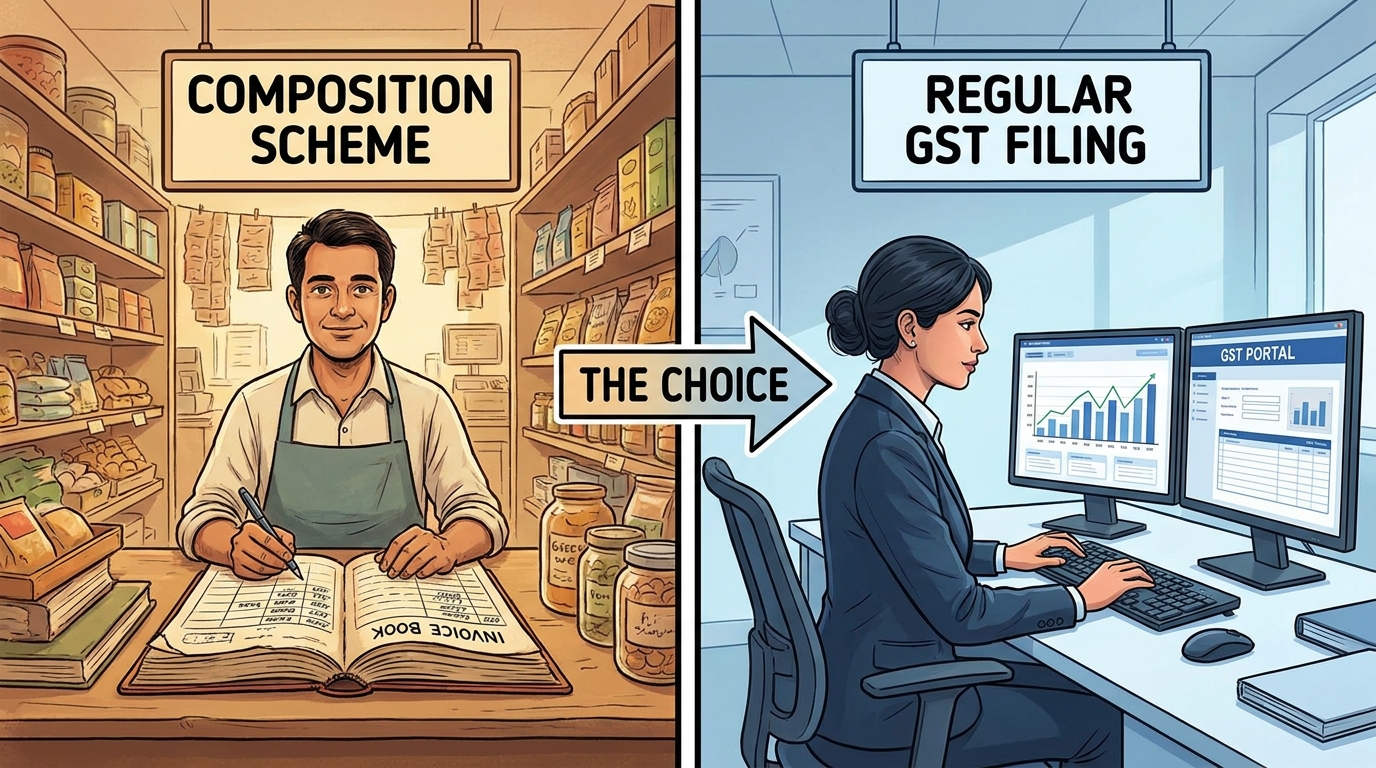
TL;DR: The GST composition scheme lets small businesses pay tax at a flat rate (1% for traders, 5% for restaurants, 6% for service providers) instead of the standard 18%, with simpler paperwork. The catch is you lose input tax credit and cannot do inter-state sales or sell through e-commerce marketplaces, so it works best for small B2C businesses with low input costs.
Introduction
Running a small business under regular GST means monthly returns, detailed invoice records, and tax rates that can climb as high as 18% or 40%. The GST composition scheme was built to fix exactly this problem for small taxpayers who don’t want the compliance load.
Under this scheme, eligible businesses pay tax at a flat rate: 1% for goods traders, 5% for restaurants, and 6% for service providers, instead of standard GST slabs. You also skip detailed record-keeping and file returns quarterly instead of monthly. The trade-off is real, though: you cannot claim input tax credit (ITC), and you cannot supply goods across state lines.
This guide is for small business owners, shopkeepers, restaurant operators, and freelancers or consultants trying to decide whether composition scheme or regular GST fits their business better. We’ll walk through eligibility, the exact tax rates, restrictions, and end with a decision framework you can apply today, not just generic advice to “talk to your CA.”
What Is the GST Composition Scheme?
The GST composition scheme is an optional tax payment method under India’s Goods and Services Tax law that lets small taxpayers pay tax at a fixed, low percentage of turnover instead of standard GST rates. It reduces paperwork by requiring only quarterly payments and an annual return, but it disallows input tax credit and restricts inter-state sales.
Who Is Eligible for GST Composition Scheme?
Eligibility depends on your annual turnover and the type of business you run. The thresholds differ by category:
| Business Type | Turnover Limit | Notes |
|---|---|---|
| Goods traders/manufacturers | Below ₹1.5 crore | Most states; some special category states have lower limits |
| Restaurants/hotels (not serving alcohol) | Below ₹1.5 crore | Food service businesses only |
| Service providers | Below ₹50 lakh | Separate composition scheme for services introduced in 2019 |
Turnover is calculated on an all-India basis using your PAN, meaning if you run multiple businesses under the same PAN, their combined turnover counts toward the limit. Businesses that manufacture ice cream, pan masala, or tobacco products cannot opt into composition scheme regardless of turnover.
Key insight: The composition scheme for service providers was a later addition, effective from April 1, 2019, capped at ₹50 lakh turnover, separate from the older goods-trader scheme.
The 3 Tax Rates Under Composition Scheme
Composition scheme tax rates are split equally between CGST and SGST, and they vary based on your business category.
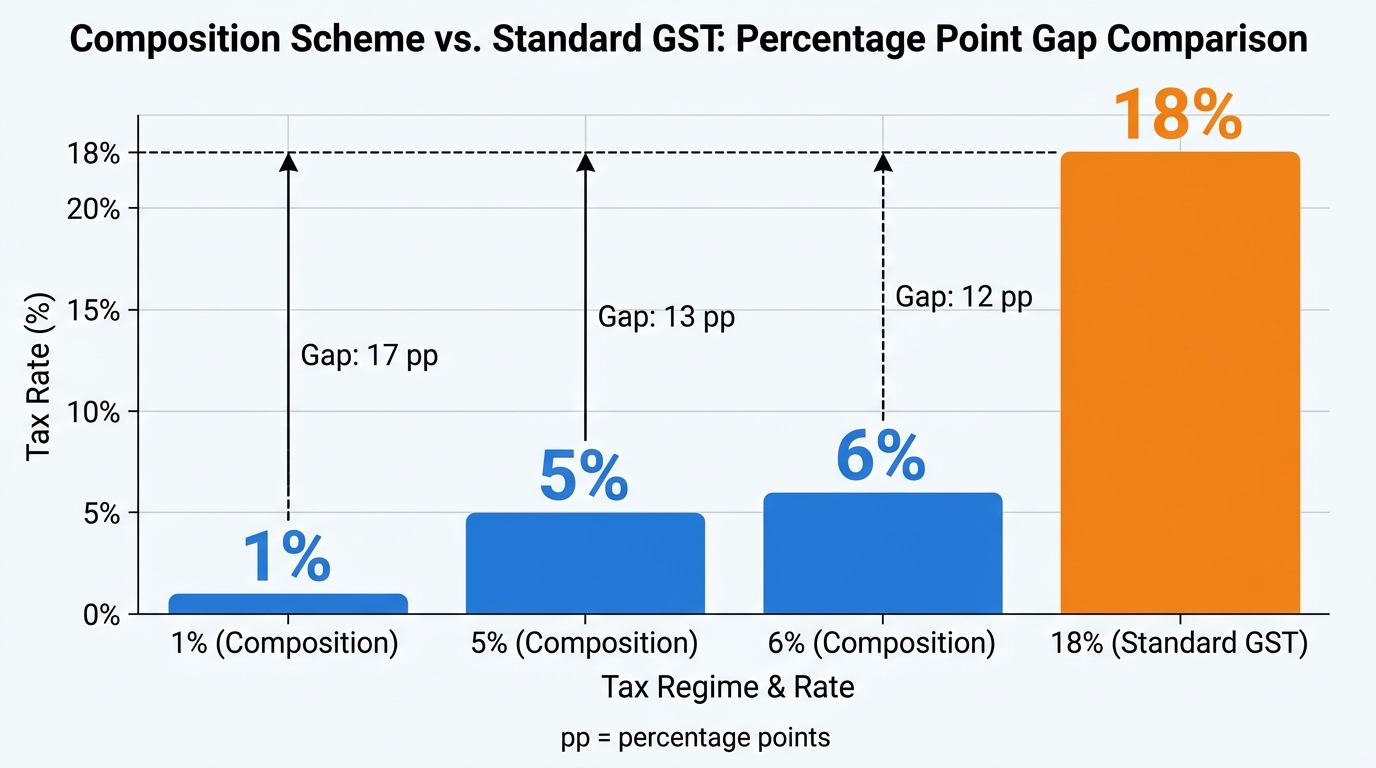
Goods traders and manufacturers: 1% total (0.5% CGST + 0.5% SGST) on turnover. This is the lowest rate under the scheme, designed for small retailers and small-scale manufacturers.
Restaurants and food service businesses: 5% total (2.5% CGST + 2.5% SGST) on turnover, applicable to restaurants not serving alcohol.
Service providers: 6% total (3% CGST + 3% SGST) on turnover, applicable to consultants, freelancers, and small service businesses under the separate services composition scheme.
Compare that to regular GST, where services are typically taxed at 18% and many goods fall in the 12% to 40% range. The composition rate is charged on your total turnover, not on profit margin, which matters for the decision framework later in this article.
Key Restrictions You Cannot Ignore
The lower tax rate comes with trade-offs that can hurt certain business models more than others.
No input tax credit (ITC). You cannot claim credit for GST paid on your purchases, raw materials, or business expenses. This matters a lot if your input costs are high relative to revenue.
No inter-state supply of goods. A composition dealer can only sell within their own state. The moment you want to sell to a customer in another state, you must exit the scheme and move to regular GST.
No e-commerce marketplace selling. You cannot sell goods through platforms like Amazon, Flipkart, or similar marketplaces while under composition scheme. Direct sales through your own website or offline store are fine.
Mandatory invoice disclosure. Every bill of supply you issue must display “Composition Taxable Person, not eligible to collect tax on supplies” at the top. You cannot issue a tax invoice, only a bill of supply, since you’re not charging GST separately to customers.
No tax collection from customers. Since composition dealers pay tax out of their own revenue at the flat rate, they cannot show GST as a separate line item on the customer’s bill the way regular GST dealers do.
Pro Tip: If even 10% of your revenue depends on inter-state sales or marketplace platforms, composition scheme will likely cost you more in lost business than it saves in tax, run the numbers before switching.
The Decision Matrix: Composition vs Regular GST
This is where most articles stop at “eligibility and rates” and leave you to guess. Here’s a concrete framework based on how your business actually operates.
Opt In to Composition Scheme If:
- Your customers are mostly B2C (retail buyers, walk-in customers, individual consumers) who don’t need GST invoices for their own tax credit claims
- Your input costs are low relative to revenue, meaning you don’t lose much by giving up ITC
- Your turnover is comfortably below the threshold for your category (₹1.5 crore for goods, ₹50 lakh for services)
- You operate within a single state and have no plans to expand inter-state in the near term
- You want simpler compliance: quarterly payments (CMP-08) and one annual return (GSTR-4) instead of monthly filings
Stay on Regular GST If:
- Your clients are B2B businesses who need proper tax invoices to claim their own input tax credit; composition dealers cannot issue these, which can make you a less attractive vendor
- Your input costs are high (raw materials, equipment, subcontracted services), since losing ITC means paying tax twice, once on inputs and again on flat-rate output
- You plan to sell inter-state or through e-commerce marketplaces like Amazon or Flipkart
- Your turnover is close to or likely to cross the composition threshold within the next year, since switching mid-year adds compliance complexity
- You want to claim ITC on business expenses like rent, equipment, or software subscriptions
Quick Comparison Table
| Factor | Composition Scheme | Regular GST |
|---|---|---|
| Tax rate | 1% to 6% flat on turnover | 5% to 40% depending on goods/services |
| Input tax credit | Not allowed | Allowed |
| Inter-state sales | Not allowed | Allowed |
| E-commerce selling | Not allowed | Allowed |
| Return filing | Quarterly payment + annual return | Monthly/quarterly returns |
| Best suited for | Small B2C retailers, local restaurants, solo service providers | B2B suppliers, inter-state sellers, high-input businesses |
Common Mistakes Businesses Make
Choosing composition scheme purely for the lower rate without checking if their B2B clients need tax invoices for ITC, which can quietly kill deals with larger business customers.
Ignoring the aggregate turnover rule across multiple businesses under the same PAN, leading to accidental non-compliance if combined turnover crosses the threshold.
Forgetting to display “Composition Taxable Person” on bills of supply, which is a compliance requirement that invites penalties during audits.
Not tracking turnover closely enough near the threshold, resulting in a forced, sometimes late, exit from the scheme mid-year with added paperwork.
Frequently Asked Questions
Who is eligible for GST composition scheme? Businesses with annual turnover below ₹1.5 crore (goods traders/manufacturers), or ₹50 lakh (service providers) are eligible. Manufacturers of ice cream, pan masala, and tobacco are excluded regardless of turnover, and turnover is calculated across all businesses under the same PAN.
What is the tax rate under GST composition scheme?The rate depends on business type: 1% (0.5% CGST + 0.5% SGST) for goods traders, 5% (2.5% + 2.5%) for restaurants, and 6% (3% + 3%) for service providers. This is charged on total turnover, not on profit margin.
Can a composition dealer sell outside their state? No, composition dealers cannot make inter-state supplies of goods. This is one of the biggest restrictions of the scheme, and any business planning to expand beyond its home state should choose regular GST instead.
Can I switch from regular GST to composition scheme? Yes, you can switch at the start of a financial year by filing Form CMP-02 before the deadline, usually before the new financial year begins. You must also reverse any input tax credit claimed on stock held as of the switch date.
What is the difference between regular GST and composition scheme? Regular GST allows input tax credit, inter-state sales, and e-commerce selling but requires monthly compliance and higher tax rates (5% to 40%). Composition scheme offers flat low rates (1% to 6%) and quarterly filing but blocks ITC, inter-state supply, and marketplace selling.
Conclusion
The GST composition scheme works well for small, single-state businesses selling mainly to individual customers with low input costs, think local retailers, small restaurants, and solo consultants who don’t need to issue tax invoices to business clients. It fails for businesses that sell B2B, operate inter-state, use e-commerce marketplaces, or carry high input costs that would otherwise qualify for meaningful ITC.
Use the decision matrix above as your starting checklist: if you tick more boxes under “opt in,” the composition scheme likely saves you both tax and paperwork. If you tick more boxes under “stay on regular,” the flat rate will cost you more in lost ITC and lost B2B business than it saves. Review your last 12 months of turnover, customer type, and input costs against this framework before filing Form CMP-02, and revisit the decision every year as your business grows toward the threshold.