
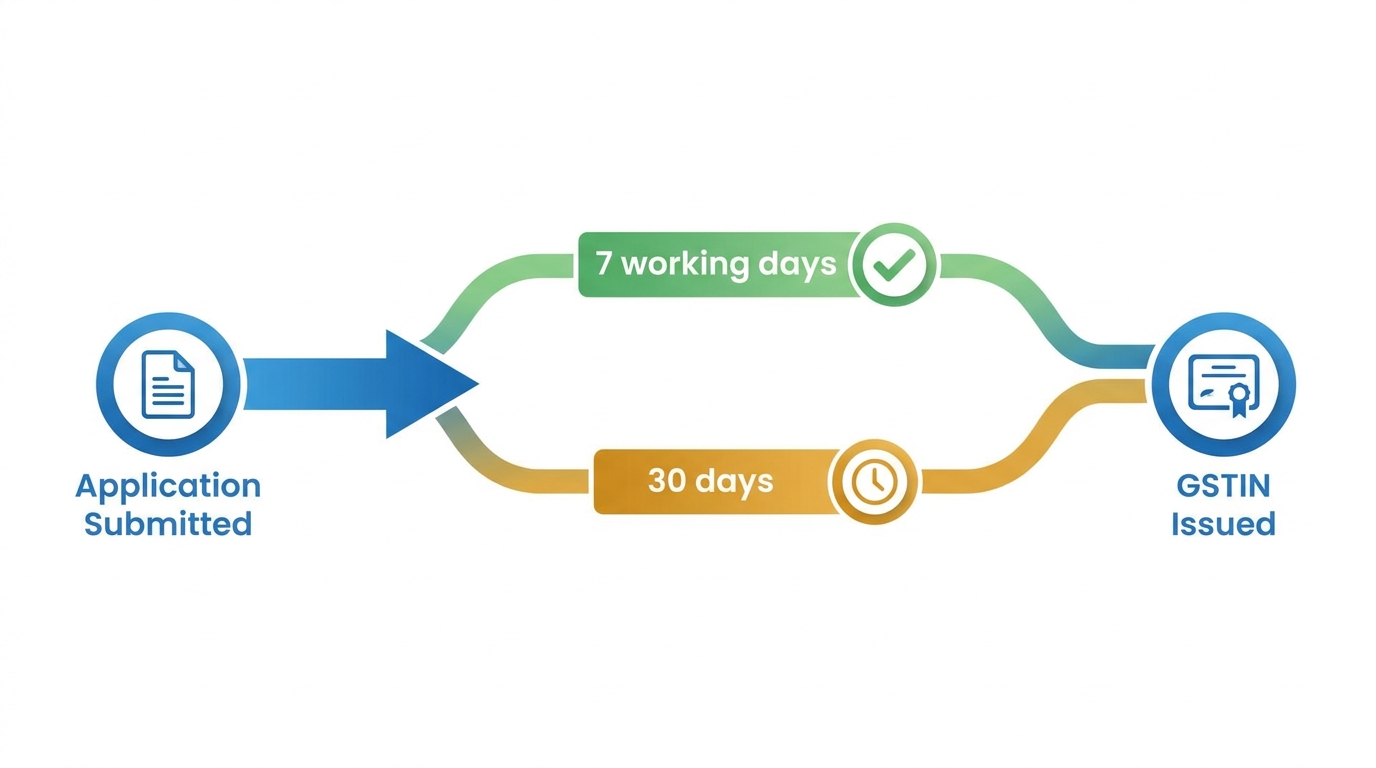
 TL;DR: GST registration is granted within 7 working days if Aadhaar authentication is completed successfully. If authentication fails, is skipped, or the officer flags the application for physical verification, the timeline extends to up to 30 days. Most delays come from failed Aadhaar checks, mismatched documents, or unanswered REG-03 clarification notices.
If you have just applied for GST registration and are refreshing the portal every hour wondering when your GSTIN will show up, here is the direct answer: 7 working days in the normal case, 30 days if things get flagged. This article breaks down exactly what happens at each stage, why some applications take longer, and what you can do to stay on the fast track.
This is written for founders, freelancers, and accountants who have already applied or are about to apply for GST registration and want a realistic timeline, not just the theoretical one printed on the GST portal.
GST Registration Time Limit: The Direct Answer
GST registration in India is normally granted within 7 working days of submitting the application, provided Aadhaar authentication is completed by the applicant. This is the standard timeline under Rule 9 of the CGST Rules.
If Aadhaar authentication is not opted for, fails, or the officer decides the application needs physical verification of the business premises, the timeline extends to up to 30 days. Some applications also get delayed further if a clarification notice (FORM GST REG-03) is issued and the response takes time to process.
Key insight: The 7-day and 30-day windows are statutory limits under the CGST Rules, not average processing times. Many applications with clean documentation and successful Aadhaar authentication are approved faster, sometimes within 3-4 working days.
What Is GST Registration Processing Time?
GST registration processing time is the number of working days between submitting FORM GST REG-01 and receiving your GSTIN (GST Identification Number). It depends primarily on whether Aadhaar authentication succeeds and whether the officer requires further verification. The two statutory windows are 7 working days (authenticated) and 30 days (unauthenticated or flagged).
Why This Timeline Matters
A delayed GSTIN is not just an inconvenience. It affects your ability to raise GST-compliant invoices, claim input tax credit, and legally start billing customers. Many businesses lose weeks of billable invoicing because they did not realize a skipped Aadhaar step would double their wait time.
Knowing the stage-by-stage breakdown also helps you spot exactly where your application is stuck, instead of assuming the entire process is just “slow.”
Stage-by-Stage Breakdown of the GST Registration Timeline
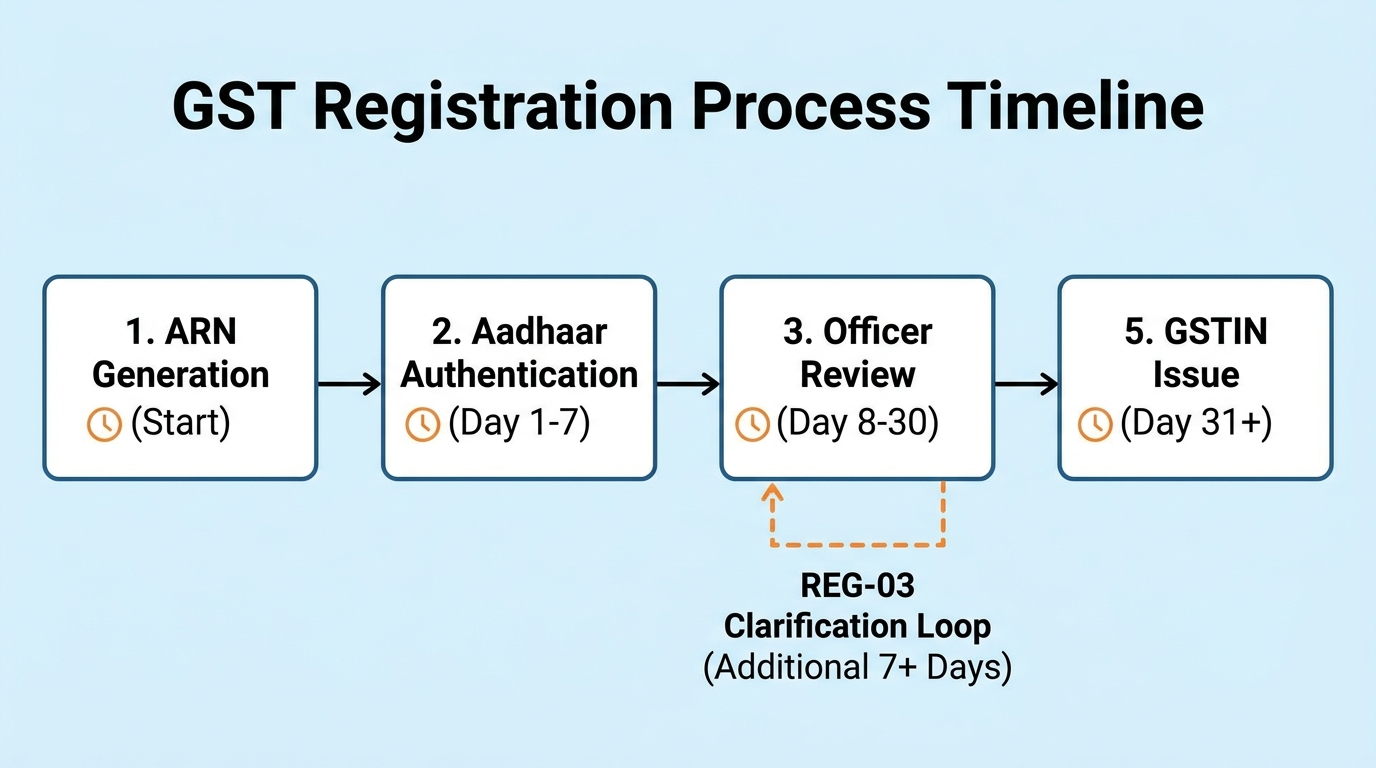
Stage 1: ARN Generation (Immediate)
Once you submit FORM GST REG-01 with all required documents, an Application Reference Number (ARN) is generated immediately, usually within minutes. This is your tracking number for the entire process and confirms your application has entered the GST system.
Stage 2: Aadhaar Authentication Window
After ARN generation, you receive a link (via email and SMS) to complete Aadhaar authentication for the primary applicant. This step is time-sensitive. You typically have a short window to complete it, and it directly determines which timeline you fall into: 7 days or 30 days.
Pro Tip: Complete Aadhaar authentication on the same day the link is sent. Applicants who delay this step by even 2-3 days often find their application automatically routed into the longer 30-day verification track.
Stage 3: Officer Review
Once authentication is done (or skipped), a GST officer reviews the application and supporting documents. If everything matches and no red flags come up, approval can happen well within the 7-day window. If document mismatches, address proof issues, or business activity concerns arise, the officer can either request physical verification or issue a clarification notice.
Stage 4: Clarification Response Window (REG-03)
If the officer is not satisfied, they issue FORM GST REG-03, asking for additional documents or clarification. You get a fixed number of days to respond via FORM GST REG-04. The clock effectively pauses on the original timeline until you respond, and then a fresh review period starts.
Stage 5: GSTIN Issue
Once the officer approves the application, either after the initial review or after clarification, the GSTIN is issued and the registration certificate becomes available for download on the GST portal.
What Causes GST Registration Delays
Most delays trace back to one of four issues:
- Skipped or failed Aadhaar authentication — pushes the application into the 30-day physical verification track automatically
- Biometric verification requirement — some applicants are asked to visit a GST Suvidha Kendra for biometric and photo capture, which adds several days depending on appointment availability
- Mismatched documents — address proof, business constitution documents, or bank details that do not match the application details trigger officer queries
- REG-03 clarification queries — every round of clarification adds days, especially if the applicant does not respond quickly or provides incomplete answers
Delay causeTypical impactHow to avoid itSkipped Aadhaar authenticationMoves to 30-day trackComplete authentication same dayFailed Aadhaar authenticationMoves to 30-day track + biometric visitEnsure Aadhaar-linked mobile number is activeMismatched documentsREG-03 notice, added daysCross-check documents before submissionIncomplete REG-03 responseRepeated notices, weeks of delayRespond fully in one go with all requested proof
The Deemed Approval Rule
If a GST officer does not take any action within the statutory window (7 working days for authenticated applications, 30 days for others), the application is deemed approved automatically. This is a safeguard built into the CGST Rules to prevent applications from sitting in limbo indefinitely.
In practice, deemed approval is not something to rely on as a strategy. It works only when the officer genuinely misses the deadline, which is uncommon for applications with any flagged discrepancy. It is far more reliable to submit a clean application the first time.
Common Mistakes That Extend the Timeline
- Submitting address proof that does not match the business address on the application
- Using a mobile number for Aadhaar authentication that is not linked to Aadhaar or is inactive
- Ignoring the Aadhaar authentication email/SMS link, letting it expire
- Responding to REG-03 notices with partial documents, triggering a second round of queries
- Applying with inconsistent business constitution details across PAN, Aadhaar, and application forms
How to Shorten Your GST Registration Timeline
The goal is simple: get every document and authentication step right on the first attempt so your application never falls into the 30-day track by mistake. This means checking address proof consistency, confirming Aadhaar-linked mobile numbers are active before submission, and preparing complete responses in advance for any anticipated officer queries.
Key insight: Applications with successful same-day Aadhaar authentication and zero document mismatches are consistently approved faster than the statutory 7-day ceiling, often in 3-5 working days.
Frequently Asked Questions
How many days does GST registration take in India? GST registration typically takes 7 working days if Aadhaar authentication is completed successfully. If authentication is skipped, fails, or physical verification is required, it can take up to 30 days. The exact time depends on document accuracy and officer review speed.
Why is my GST registration taking longer than 7 days? This usually happens because Aadhaar authentication was not completed, failed, or the officer flagged your application for physical verification. A pending REG-03 clarification notice is another common reason. Check your registered email and the GST portal for any pending action requests.
What is the ARN and how long is it valid? The ARN (Application Reference Number) is generated immediately after you submit your GST registration application, and it is used to track your application status. It remains valid until your application is either approved, rejected, or you are required to resubmit after a clarification request.
What happens if the GST officer does not respond in time? If the officer takes no action within the statutory window (7 or 30 days), your application is deemed approved automatically under the CGST Rules. This is a legal safeguard, but it should not be relied on as a strategy since flagged applications rarely go unreviewed.
Can GST registration be rejected after applying? Yes, an application can be rejected if the officer finds discrepancies, incomplete documents, or an unsatisfactory response to a REG-03 clarification notice. You will receive a rejection order with reasons, and you can typically reapply after correcting the flagged issues.
Conclusion
The GST registration time limit in India comes down to two numbers: 7 working days with successful Aadhaar authentication, and up to 30 days if authentication fails or physical verification kicks in. The real difference between the two tracks almost always comes down to document accuracy and how quickly you complete Aadhaar authentication after applying.