
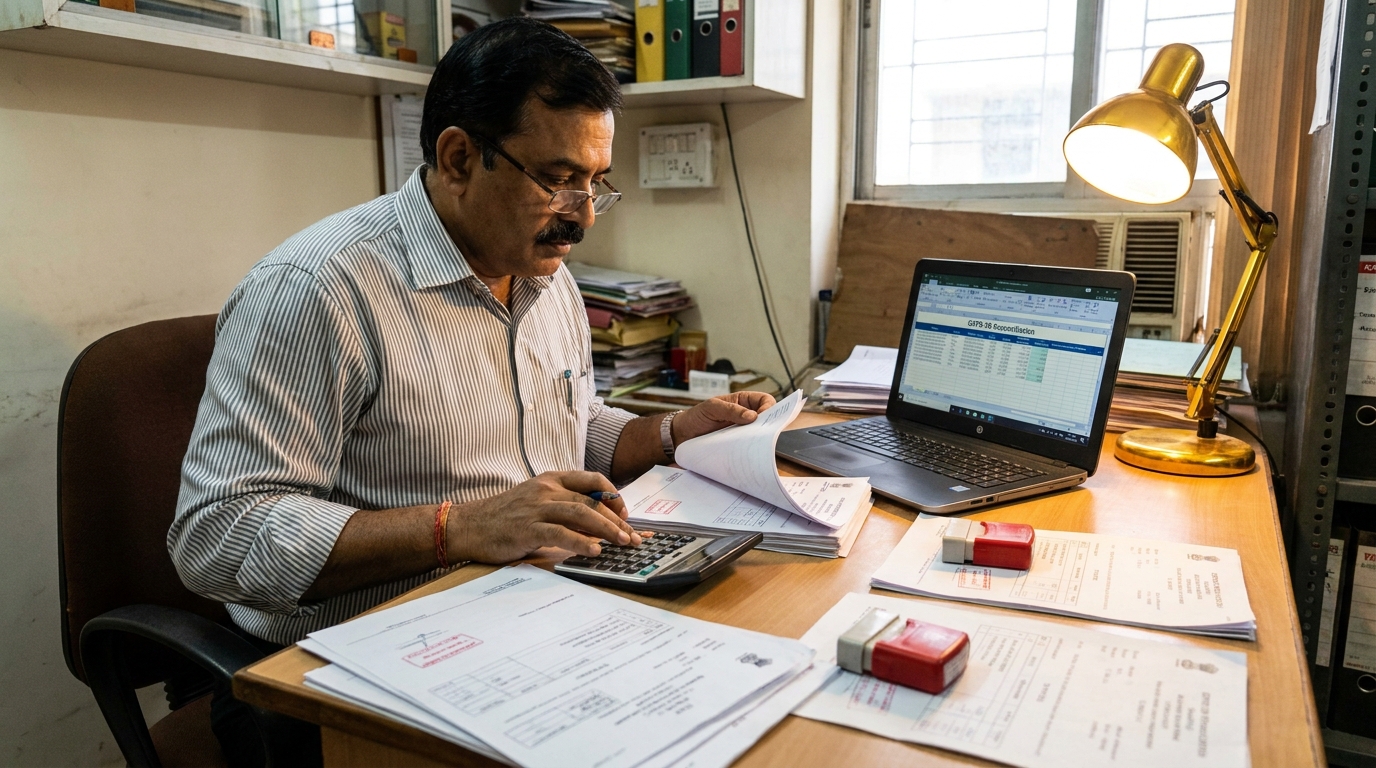
TL;DR: Most GST penalties hit SMEs because of a handful of repeatable, avoidable errors like claiming blocked ITC, skipping GSTR-2B reconciliation, or forgetting reverse charge on legal and GTA services. This guide breaks down the 10 most common GST mistakes with real scenarios so you can check your own filings today. Each section also gives you the exact fix.
Introduction
A GST notice rarely shows up because of bad luck. It shows up because of a specific, identifiable mistake that repeats month after month until the department flags it. Common GST mistakes for SMEs in India range from claiming input tax credit on items the law specifically blocks, to skipping e-way bills for goods movement above ₹50,000, to forgetting that e-commerce sellers do not get the ₹20 lakh registration threshold that regular sellers enjoy.
This article is for small and medium business owners, accountants, and finance teams in India who file GST returns monthly or quarterly and want to catch errors before the tax department does. Each of the 10 mistakes below includes what it looks like in practice, why it happens, what it costs you, and the exact fix. By the end, you should be able to point to at least one mistake you are currently making.
What Are GST Mistakes and Why Do They Matter?
GST mistakes are errors in tax calculation, credit claims, invoicing, or return filing that violate provisions of the Central Goods and Services Tax Act, 2017. They matter because they trigger automated mismatch notices, interest at 18% per annum on short payments, and penalties that can reach 100% of the tax involved in cases of fraud. Most mistakes are procedural, not intentional, which means they are also entirely preventable with the right checks.
Key insight: The GST Network’s automated scrutiny system cross-checks GSTR-1, GSTR-2B, and GSTR-3B data every filing cycle, so mismatches that used to go unnoticed for years now generate notices within weeks.
Mistake 1: Claiming ITC on Blocked Credits
Section 17(5) of the CGST Act blocks input tax credit on specific categories, but many SMEs claim it anyway because the invoice looks like any other business expense.
What goes wrong: A common scenario is a company claiming ITC on food and beverage bills from client meetings, personal use of a director’s car, club membership fees, or construction costs for an office building. All four are explicitly blocked under Section 17(5), regardless of whether the expense is genuinely business-related.
Why it happens: Accounting teams often apply a blanket rule of “if it’s a business expense, claim the ITC,” without checking the blocked credit list first.
The fix: Maintain a blocked-credit checklist covering food and beverages, outdoor catering, health and life insurance (unless mandatory for employees), rent-a-cab, club memberships, and works contract services for immovable property. Cross-check every ITC claim above ₹10,000 against this list before filing GSTR-3B.
Pro Tip: Set up a separate ledger code in your accounting software for blocked-credit expenses so they never accidentally flow into your ITC claim column.
Mistake 2: Getting Place of Supply Wrong for B2C Services
Place of supply rules determine whether a transaction is taxed as CGST+SGST or IGST, and getting this wrong is one of the most common GST mistakes for service-based SMEs.
What goes wrong: A Mumbai-based digital marketing agency sells a service to an individual customer in Bangalore. Instead of charging IGST for this inter-state B2C supply, the accounts team charges CGST+SGST as if it were a local Maharashtra sale, because that is the default template in their billing software.
Why it happens: Most invoicing software defaults to the seller’s state tax structure unless the place of supply field is manually corrected for each transaction.
The fix: For B2C services, place of supply is generally the location of the service recipient, not the supplier. Train billing staff to check the customer’s state on every invoice, and audit a sample of 20 invoices per month specifically for place-of-supply accuracy.
Mistake 3: Missing Reverse Charge on Notified Services
Reverse charge mechanism (RCM) shifts the liability to pay GST from the supplier to the recipient for specific notified categories, and SMEs frequently forget to self-invoice and pay this tax.
What goes wrong: A company hires a lawyer for a contract review, pays the legal fee, and takes no further action because the lawyer did not charge GST. Under RCM, the company itself owes 18% GST on that legal fee and must pay it in cash, then can claim it back as ITC. The same gap appears with Goods Transport Agency (GTA) freight charges and security services from unregistered suppliers.
Why it happens: Businesses assume that if the vendor did not charge GST, no GST is due at all.
The fix: Build a list of RCM-notified services relevant to your business (legal fees, GTA, security services, sponsorship, and services from a director) and flag every such invoice for self-assessment before month-end closing.
RCM CategoryWho Pays TaxCommon RateLegal services from advocateRecipient (business)18%Goods Transport Agency (GTA)Recipient (business)5%Security services (unregistered supplier)Recipient (business)18%Director’s services to companyRecipient (business)18%
Mistake 4: Not Reconciling GSTR-2B Before Claiming ITC
GSTR-2B is the auto-generated statement showing ITC available to you based on what your suppliers have reported. Claiming ITC without matching it against GSTR-2B is one of the fastest routes to a mismatch notice.
What goes wrong: An SME claims ITC based on its purchase register, without checking whether the supplier has actually filed GSTR-1 and reported that invoice. If the supplier is late or defaults on filing, that ITC never appears in GSTR-2B, creating an automatic discrepancy the moment GSTR-3B is filed.
Why it happens: Reconciliation feels like an extra step when the purchase invoice is already in hand and looks valid.
The fix: Reconcile GSTR-2B against your purchase register every single month before filing GSTR-3B, not quarterly or “when there’s time.” Flag any invoice missing from GSTR-2B and follow up with the supplier immediately, since ITC can only be claimed once it reflects in GSTR-2B under the current rules.
Key insight: GSTR-2B based ITC claims became mandatory after amendments to Rule 36(4), removing the earlier provisional ITC buffer that used to give businesses more flexibility.
Mistake 5: E-Commerce Sellers Not Registering Under GST
Many small sellers believe the standard ₹20 lakh turnover threshold for GST registration applies to them if they sell through Amazon, Flipkart, or Meesho. It does not.
What goes wrong: A home-based seller with ₹8 lakh in annual sales through an online marketplace assumes they are under the threshold and skip GST registration entirely. Marketplace sellers are required to register for GST regardless of turnover, because Section 24 of the CGST Act makes registration compulsory for anyone supplying goods through an e-commerce operator.
Why it happens: The ₹20 lakh (or ₹40 lakh for goods in some states) threshold is widely known for regular businesses, but the e-commerce exception is less publicized.
The fix: If you sell any goods through an online marketplace, register for GST before your first sale, not after you cross a turnover threshold. Service providers selling through e-commerce platforms do get the standard threshold exemption, so check whether you are selling goods or services before assuming you need to register.
Mistake 6: Not Filing NIL Returns
A common misconception is that no business activity means no filing obligation. This is false, and it is one of the more expensive common GST mistakes because the penalty accrues daily.
What goes wrong: A registered business has zero sales and zero purchases in a given month, so the owner skips filing GSTR-3B entirely, assuming there is nothing to report. Late fees of ₹20 per day (₹10 CGST + ₹10 SGST) start accumulating from the due date and keep adding up until the NIL return is actually filed.
Why it happens: The word “NIL” makes the return feel optional, when it is actually mandatory as long as the GST registration remains active.
The fix: File NIL returns every period without exception until you formally cancel your GST registration. Most GSTN portals now allow NIL GSTR-3B filing via a simple SMS, which takes under two minutes.
Mistake 7: Cancelling GST Registration Without Reversing ITC
When a business closes or voluntarily cancels its GST registration, it must reverse any unutilized ITC on inputs, semi-finished goods, finished goods, and capital goods held in stock on the date of cancellation.
What goes wrong: A business owner cancels their GST registration after winding down operations but skips the ITC reversal on remaining stock and capital assets. The department later raises a tax demand equal to the ITC that should have been reversed, sometimes years after the cancellation was processed.
Why it happens: Business owners treat cancellation as an administrative formality rather than a taxable event requiring its own calculation.
The fix: Before filing for cancellation, calculate ITC reversal on closing stock and the residual value of capital goods (based on a straight-line depreciation formula prescribed under the rules), and pay this amount through Form GSTR-10, the final return.
Mistake 8: Not Maintaining E-Way Bills Above ₹50,000
An e-way bill is mandatory for the movement of goods where the consignment value exceeds ₹50,000, whether the movement is for sale, stock transfer, or job work.
What goes wrong: A manufacturer sends goods worth ₹65,000 to a job worker in another state without generating an e-way bill, assuming that job work transfers are exempt. In transit, a GST enforcement check finds the goods unaccompanied by a valid e-way bill, resulting in detention of goods and a penalty that can equal 200% of the tax amount.
Why it happens: Businesses often assume e-way bills only apply to direct sales, not to stock transfers, job work, or returns.
The fix: Generate an e-way bill for any goods movement above ₹50,000 regardless of the reason for transport, including branch transfers, job work, and goods sent for exhibition. Assign one team member to own e-way bill compliance so it never depends on whoever happens to be dispatching goods that day.
Mistake 9: Wrong HSN Code on Invoices
The Harmonized System of Nomenclature (HSN) code determines the applicable GST rate on a product, and an incorrect code is a direct trigger for a rate dispute and audit notice.
What goes wrong: A business selling packaged snacks classifies its product under an HSN code meant for a lower-taxed category, either due to a genuine classification error or an attempt to reduce the tax rate. During a GST audit, the department reclassifies the product to the correct HSN code, resulting in a demand for the tax shortfall plus interest and, in cases viewed as intentional, a penalty.
Why it happens: HSN classification requires technical knowledge of product composition and use, and many SMEs copy the code from a competitor’s invoice or a generic online list without verification.
The fix: Verify your HSN code against the official GST rate schedule or consult a GST practitioner for products with ambiguous classification. Businesses with turnover above ₹5 crore must use a 6-digit HSN code, while smaller businesses can use 4-digit codes, so confirm which tier applies to you.
Mistake 10: Not Issuing Credit Notes for Returned Goods
When goods are returned or an invoice needs correction after issuance, a credit note must be issued and reported in GSTR-1. Skipping this step creates a permanent mismatch between your reported output tax and your actual sales.
What goes wrong: A wholesaler accepts a return of goods worth ₹1,20,000 from a retailer but simply adjusts the amount informally in the next invoice instead of issuing a formal credit note under Section 34. The original invoice’s GST liability stays on record as if the sale still stands, inflating output tax liability and creating a mismatch that surfaces during reconciliation or audit.
Why it happens: Businesses treat returns as a bookkeeping adjustment rather than a formal GST document with its own reporting requirement.
The fix: Issue a credit note for every sales return, discount, or invoice correction, and report it in the GSTR-1 of the same month or before the September return of the following financial year, whichever is earlier. This adjusts your output tax liability automatically and keeps your books aligned with your GST returns.
How to Self-Audit for These GST Mistakes
MistakeQuick Self-CheckFrequency to ReviewBlocked ITCScan ITC claims for food, vehicles, club feesMonthlyPlace of supplyCheck customer state on B2C invoicesMonthlyReverse chargeList all legal, GTA, security vendor paymentsMonthlyGSTR-2B mismatchReconcile purchase register vs GSTR-2BBefore every GSTR-3BE-commerce registrationConfirm registration status if selling onlineOnce, then annuallyNIL returnsConfirm filing even with zero activityEvery return periodITC reversal on cancellationCalculate stock and capital goods valueAt cancellation onlyE-way billsCheck all movements above ₹50,000Every dispatchHSN codesCross-verify with official rate scheduleQuarterlyCredit notesMatch returns against credit notes issuedMonthly
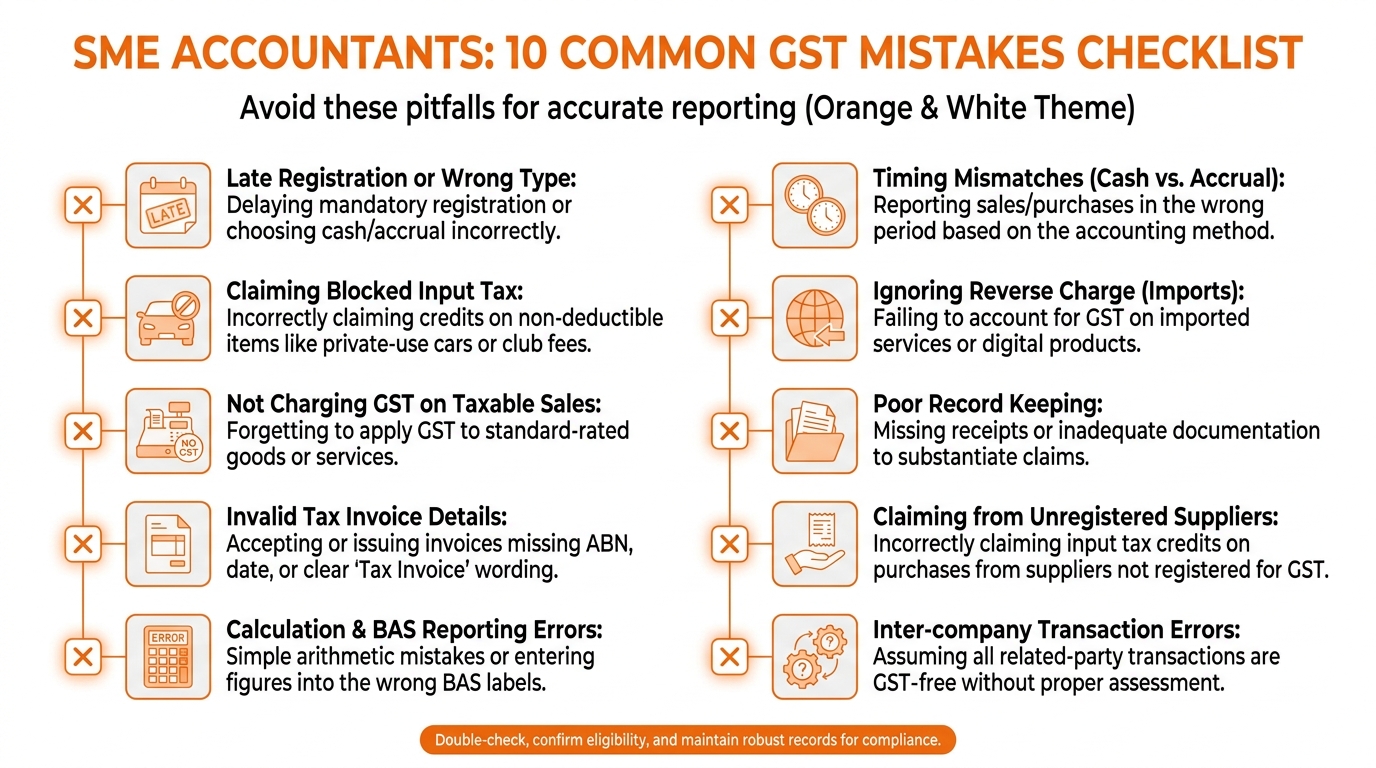
Frequently Asked Questions
What are common GST mistakes made by small businesses? The most common GST mistakes include claiming blocked input tax credit, missing reverse charge on legal and GTA services, wrong HSN codes, skipping e-way bills above ₹50,000, and not reconciling GSTR-2B before filing returns. Most stem from treating GST compliance as a monthly formality rather than a line-by-line check.
What is the penalty for wrong ITC claim? Wrong ITC claims attract interest at 18% per annum on the excess amount from the date of claim until reversal. If the claim is found to be fraudulent rather than a genuine error, penalties can go up to 100% of the tax involved, along with possible prosecution in severe cases.
What happens if I file GST returns late? Late filing triggers a late fee of ₹50 per day (₹20 per day for NIL returns), split equally between CGST and SGST, subject to a maximum cap based on turnover. Interest at 18% per annum also applies on any tax amount that remains unpaid past the due date.
How do I avoid GST notices? Avoiding GST notices means reconciling GSTR-2B monthly, verifying HSN codes, generating e-way bills for all qualifying movements, and filing returns on time including NIL returns. Most notices are triggered by automated mismatches between GSTR-1, GSTR-2B, and GSTR-3B, so consistent monthly reconciliation is the single most effective prevention step.
What is the most common reason for GST audit? Mismatches between GSTR-1, GSTR-3B, and GSTR-2B are the most common trigger for a GST audit or scrutiny notice. Other frequent triggers include unusually high ITC claims relative to output tax, missing e-way bills, and inconsistent HSN code usage across invoices.
Conclusion
These 10 common GST mistakes account for the majority of penalty notices SMEs receive in India, and every single one is preventable with a monthly checklist rather than a year-end scramble. From blocked ITC claims and reverse charge gaps to missing e-way bills and wrong HSN codes, the pattern is the same: small, repeatable errors that automated GSTN scrutiny now catches within weeks instead of years.
If you recognized your business in even one of these scenarios, start with a GSTR-2B reconciliation for your last three filed returns this week.