
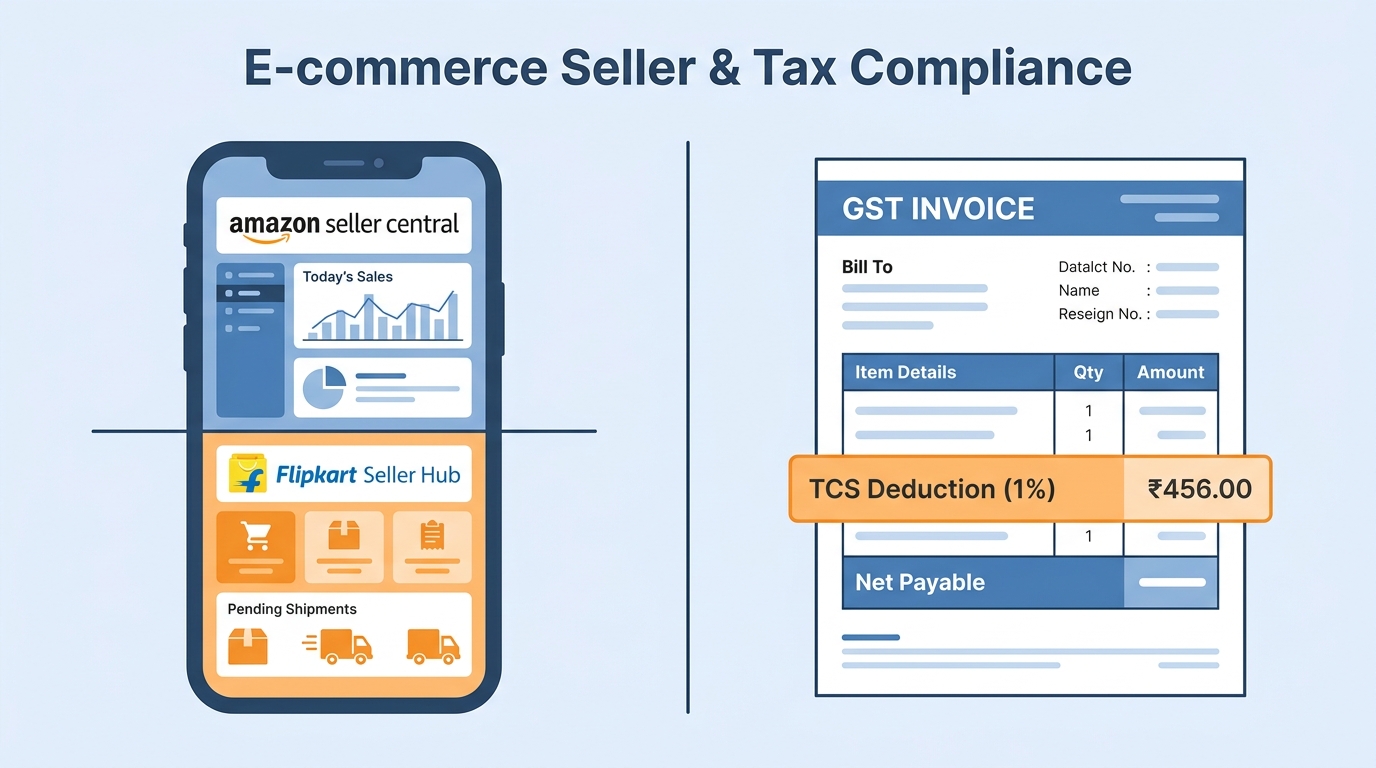
TL;DR: Every marketplace seller on Amazon, Flipkart, or Meesho must register for GST from day one, there is no ₹20 lakh threshold exemption like regular businesses get. Marketplaces also deduct 1% TCS on every payment, which sellers must reconcile and claim back the collected amount in it’s Electronic Cash Ledger. Sellers running their own website can still use the ₹20 lakh threshold, but must set up GST-compliant payment gateway integration separately.
Selling on Amazon, Flipkart, or Meesho? Every marketplace seller must register for GST from their first rupee of sales, the ₹20 lakh threshold does not apply to sellers using e-commerce operators. This single rule catches thousands of new sellers off guard every year, leading to penalties, blocked payouts, and account suspensions on marketplaces.
This guide is for anyone selling products through Amazon, Flipkart, Meesho, Myntra, or a self-hosted online store in India. It covers only the GST rules that are specific to e-commerce, not the general registration process you can find elsewhere. If you need the basics of GST registration first, check our complete GST registration guide before continuing.
What Is GST for E-Commerce Sellers?
GST for e-commerce sellers refers to the tax compliance rules that apply specifically to businesses selling through online marketplaces or their own websites. Under Section 24(ix) of the CGST Act, any person supplying goods through an e-commerce operator must register for GST regardless of turnover. This differs sharply from regular businesses, which get a ₹20 lakh (or ₹40 lakh for goods, in some states) exemption threshold.
Why This Matters More Than Generic GST Rules
Most GST content online talks about the standard ₹20 lakh threshold and stops there. That advice is wrong for anyone selling on a marketplace. Sellers who assume they are exempt because their turnover is low end up with blocked listings, held payments, and notices from the tax department.
Key insight: Marketplaces like Amazon and Flipkart legally cannot onboard a seller without a valid GSTIN, even for a single product listing. This is enforced at the platform level, not just by the tax department.
Understanding these e-commerce-specific rules from day one saves new sellers from having to pause operations mid-way to fix compliance gaps.
Rule 1: No Threshold Exemption for Marketplace Sellers
Section 24(ix) of the CGST Act makes GST registration mandatory for every person who supplies goods or services through an e-commerce operator, irrespective of turnover. A seller doing ₹50,000 in monthly sales on Meesho has the exact same registration obligation as one doing ₹50 lakh.
This applies to:
- Sellers on Amazon, Flipkart, Meesho, Myntra, Ajio, and similar platforms
- Both goods and service providers using these platforms
- New sellers, even in their first month of operations
Exception: This mandatory rule applies to goods sellers. Service providers selling through e-commerce operators (like freelancers on certain platforms) may still get threshold exemption in specific cases under Section 9(5), depending on the notified services list. Goods sellers get no such relief.
Pro Tip: Apply for GST registration before you complete your marketplace seller onboarding. Most platforms will not let you list a single product without a valid GSTIN uploaded first, so build in 5-7 working days for approval before your planned launch date.
Rule 2: How TCS Works for Marketplace Sellers
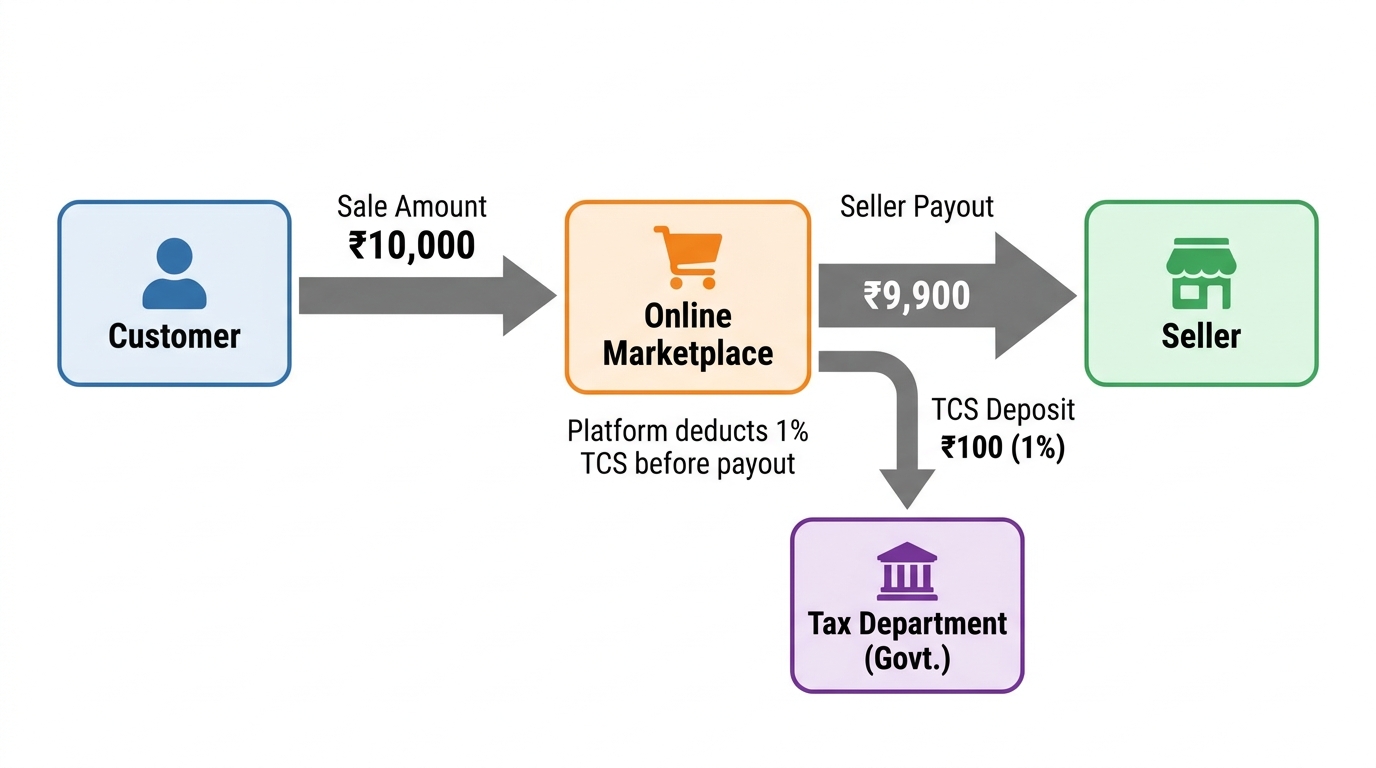
TCS, or Tax Collected at Source, is a mechanism unique to e-commerce transactions under Section 52 of the CGST Act. Marketplaces like Amazon and Flipkart are required to deduct 1% TCS (0.5% CGST + 0.5% SGST, or 1% IGST for interstate sales) from the payment due to each seller before releasing funds.
Here is how it plays out in practice:
- A customer buys a product worth ₹10,000 on Flipkart
- Flipkart collects the payment and deducts 1% TCS (₹100) before crediting the seller
- The seller receives ₹9,900 in their bank account (minus any marketplace commission)
- Flipkart deposits the ₹100 TCS with the government under the seller’s GSTIN
- This amount shows up in the seller’s GSTR-2A/2B
Claiming Back TCS in GSTR-3B
TCS is not an extra tax, it is an advance collection that sellers can claim back as credit. The process works like this:
- TCS deducted by marketplaces reflects in the GSTR-2A and GSTR-2B returns automatically
- Sellers must report and claim this TCS credit in it’s Electronic Cash Ledger from “TDS/TCS Credit”
- This claimed amount can be used to offset actual GST liability or any other payment to be made in cash
- Any excess TCS credit carries forward and can be claimed as a refund
Pro Tip: Reconcile TCS figures against sales figures every quarter, not just at year-end. Discrepancies between what Amazon or Flipkart reports and what shows in your GST portal are common, and catching them early prevents mismatched refund claims.
Rule 3: Returns and GST Reversal on E-Commerce Sales
Product returns are far more frequent in e-commerce than in offline retail, often 15-25% of orders depending on the category, and each return has GST implications that sellers frequently miss.
Credit Note Process
When a customer returns a product, the seller must issue a credit note referencing the original invoice. This credit note reduces the seller’s output tax liability for that period. Key requirements:
- Credit notes must be issued within the timeline prescribed under Section 34 of the CGST Act
- The credit note must clearly reference the original invoice number and date
- GST already paid on the original sale gets adjusted against this credit note in the same or a later GSTR-1
Key insight: Unreconciled returns are one of the most common triggers for GST notices to e-commerce sellers, because the mismatch between reported sales and marketplace settlement reports gets flagged during department cross-checks.
Rule 4: Own Website vs Marketplace GST Treatment
Sellers running their own e-commerce website (using Shopify, WooCommerce, or a custom build) are treated differently from marketplace sellers because there is no e-commerce operator collecting TCS on their behalf.
| Factor | Own Website | Marketplace (Amazon/Flipkart/Meesho) |
|---|---|---|
| Registration threshold | ₹20 lakh (₹40L for goods in some states) applies | No threshold, mandatory from ₹1 |
| TCS deduction | Not applicable | 1% TCS deducted on every payment |
| GST return filing | Standard GSTR-1 and GSTR-3B | GSTR-1, GSTR-3B, plus TCS credit claim |
| Payment gateway setup | Must independently ensure GST invoicing on checkout | Handled largely by marketplace systems |
| Multi-state selling | Needs registration in states with warehouses/stock | Same rule applies, plus operator’s TCS by state |
Setting Up Payment Gateway Integration Correctly
For sellers below the ₹20 lakh threshold running their own website, GST registration is technically optional until they cross it. However, once registered, the payment gateway and invoicing system must be configured correctly:
- The checkout system should auto-generate GST-compliant invoices with GSTIN, HSN codes, and correct tax rates
- Payment gateways like Razorpay or PayU do not deduct TCS since they are not classified as e-commerce operators under Section 52
- Sellers must independently track and pay their own GST liability without any TCS credit to offset
Many sellers who scale from a marketplace to their own website assume the same TCS credit system applies. It does not, and this is a frequent, costly assumption.
Common Mistakes E-Commerce Sellers Make
Several recurring errors show up across GST audits and marketplace account suspensions:
- Delaying registration: Waiting to “see how sales go” before registering, then getting blocked from listing products
- Ignoring TCS reconciliation: Not matching TCS with GSTR-2A, leading to lost credit or duplicate claims
- Skipping credit notes on returns: Recording returns only in internal accounting without issuing GST credit notes, causing mismatched output tax
- Assuming one GSTIN covers all states: Sellers storing inventory in a marketplace’s fulfillment centers across multiple states often need registration in each of those states
- Mixing own-website and marketplace sales in one return without separation: Making reconciliation difficult when marketplace settlement reports do not match bank credits
Pro Tip: Keep a separate ledger column for TCS deducted by each marketplace (Amazon, Flipkart, Meesho tend to report slightly differently). This makes quarterly reconciliation far faster than trying to untangle combined settlement reports later.
Frequently Asked Questions
Does an e-commerce seller need GST registration? Yes, mandatorily. Under Section 24(ix) of the CGST Act, anyone supplying goods through an e-commerce operator like Amazon, Flipkart, or Meesho must register for GST regardless of turnover. The usual ₹20 lakh exemption threshold does not apply to marketplace sellers.
How does TCS work for Amazon and Flipkart sellers? Marketplaces deduct 1% TCS from the payment due to each seller before crediting their bank account. This deducted amount is deposited with the government under the seller’s GSTIN and reflects in GSTR-2A / 2B for reconciliation.
How do I claim TCS deducted by Amazon in my GST return? Claim the TCS amount in Form GSTR-8A “TDS/TCS Credit” for the relevant filing period and get the credit in Electronic Cash Ledger. This claimed credit offsets your actual GST liability, and any excess amount carries forward or can be claimed as a refund.
Do I need separate GST for Amazon and my own website? No, one GSTIN per registered state covers both your marketplace and website sales. However, marketplace sales involve TCS deduction and reconciliation, while own-website sales do not, so track them separately in your accounting records.
What GST rate applies to my products on Flipkart? The GST rate depends on your product’s HSN code, not the platform you sell on. Rates typically range from 0% to 28% based on product category, so check the applicable HSN code for accurate classification before listing.
Conclusion
GST for e-commerce sellers in India works differently from standard business registration, and the gap between the two catches new sellers every day. The core rule to remember: marketplace sellers on Amazon, Flipkart, or Meesho must register from their very first sale, with no ₹20 lakh threshold protection, while TCS deduction and reconciliation become an ongoing part of monthly compliance. Returns require proper credit note handling, and sellers running their own website need to configure GST-compliant invoicing independently since no TCS applies there.
If you are about to start selling on a marketplace or are already facing TCS reconciliation issues, get your GST registration and compliance process reviewed before it turns into blocked payouts or tax notices.