
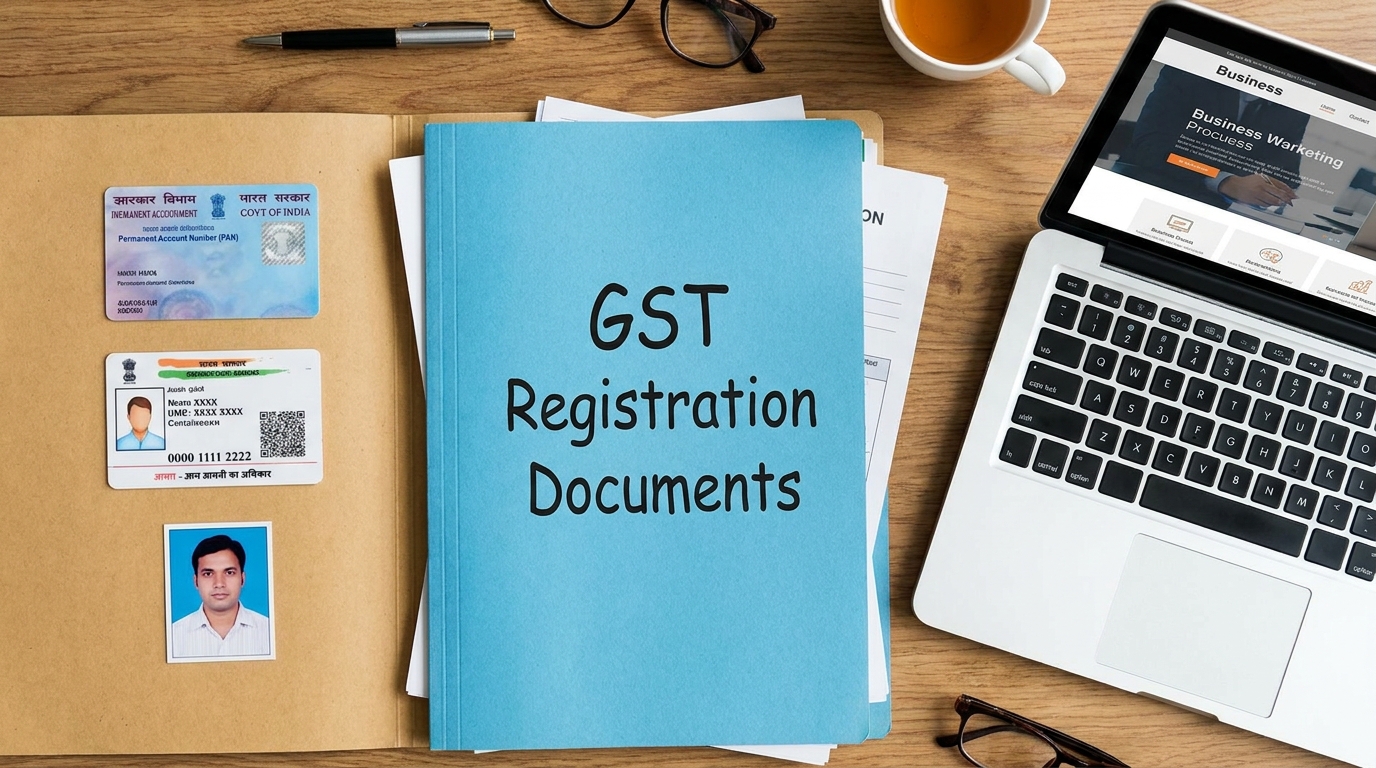
TL;DR: You must provide a PAN card, Aadhaar card, business registration proof, address proof, bank statement, and photos to apply for GST. Ensure all uploaded files are strictly in JPG or PDF format and under 1MB to avoid application rejection.
If you’re in the process of registering and want to know the exact documents required for GST registration in India, here’s a quick checklist. To complete your GST registration, you’ll need the following documents::
- A mobile number and email ID (Mandatory for OTP)
- A Permanent Account Number (PAN) card
- An Aadhaar card
- Trade name of business, if any
- Proof of business registration like Certificate of incorporation, Trust Deed etc like property tax receipt, rent agreement.
- Address proof of the principal place and all additional places of businesses, if any.
- A bank account statement or cancelled cheque (May be uploaded within 30 days of registration)
- KYC details along with passport-size photos, residential address and unique mobile and email ID of all promoters
- KYC details along with passport-size photos, residential address and unique mobile and email ID of all authorised signatories
- Authorisation letter and board resolution for authorised signatories
- Electricity Board details and consumer number, wherever applicable
- 5 major goods / services to be dealt in
- Trade license and Professional Tax Certificate, if mandatory in the state.
This guide is designed for business owners, freelancers, and tax professionals who need to organize their files before submitting an application on the government portal or through DJAS advisory services.
What Is GST Registration?
GST registration is the process of registering a business with the Goods and Services Tax Network (GSTN). It is mandatory for Indian businesses crossing the ₹40 lakh annual turnover threshold for goods (₹20 lakh for services), granting them a legally recognized 15-digit Goods and Services Tax Identification Number (GSTIN).
Document Checklists by Business Type
While the core documents remain the same, the Central Board of Indirect Taxes and Customs (CBIC) requires specific registration proofs depending on your legal business structure.
Sole Proprietorships
A proprietorship is the simplest structure, tying the business identity directly to the owner.
- A mobile number and email ID (Mandatory for OTP)
- A Permanent Account Number (PAN) card
- An Aadhaar card
- Trade name of business, if any
- Address proof of the principal place and all additional places of businesses, if any, like property tax receipt, rent agreement.
- A bank account statement or cancelled cheque (May be uploaded within 30 days of registration)
- KYC details along with passport-size photos and residential address of the proprietor
- KYC details along with passport-size photos, residential address and unique mobile and email ID of all authorised signatories, if any, alongwith authorisation letter for authorised signatories
- Electricity Board details and consumer number, wherever applicable
- 5 major goods / services to be dealt in
- Trade license and Professional Tax Certificate, if mandatory in the state.
- Bank account statement or a cancelled cheque showing the business’ name
Partnerships and LLPs
For Partnerships and Limited Liability Partnerships (LLPs), the entity is distinct from individual partners.
- A mobile number and email ID (Mandatory for OTP)
- A Permanent Account Number (PAN) card
- An Aadhaar card
- Trade name of business, if any
- Partnership deed
- Address proof of the principal place and all additional places of businesses, if any like property tax receipt, rent agreement.
- A bank account statement or cancelled cheque (May be uploaded within 30 days of registration)
- KYC details along with passport-size photos, residential address and unique mobile and email ID of all promoters
- KYC details along with passport-size photos, residential address and unique mobile and email ID of all authorised signatories, if any, alongwith authorisation letter for authorised signatories.
- Electricity Board details and consumer number, wherever applicable
- 5 major goods / services to be dealt in
- Trade license and Professional Tax Certificate, if mandatory in the state.
Private Limited Companies (Pvt Ltd)
Companies require extensive documentation to prove corporate existence and directorship.
- A mobile number and email ID (Mandatory for OTP)
- A Permanent Account Number (PAN) card
- An Aadhaar card
- Trade name of business, if any
- Certificate of incorporation
- Address proof of the principal place and all additional places of businesses, if any, like property tax receipt, rent agreement.
- A bank account statement or cancelled cheque (May be uploaded within 30 days of registration)
- KYC details along with passport-size photos, residential address and unique mobile and email ID of all directors
- KYC details along with passport-size photos, residential address and unique mobile and email ID of all authorised signatories
- Authorisation letter and board resolution for authorised signatories
- Electricity Board details and consumer number, wherever applicable
- 5 major goods / services to be dealt in
- Trade license and Professional Tax Certificate, if mandatory in the state.
Key insight: Over 20% of GST applications face delays due to mismatched director details between the MCA database and the GST portal. Always ensure PAN data aligns perfectly.
Address Proof Specifics
Providing valid address proof is one of the strictest requirements for GST registration. The GST portal categorizes premises into owned or rented spaces, each requiring different documentation.
If the property is rented or leased: You must provide a valid rent agreement or lease deed. In addition, a proof of ownership of the property (such as a property tax receipt, electricity bill, or other ownership document) belonging to the landlord must be uploaded to establish that they are the lawful owner and are entitled to lease or rent the premises.
If the property is owned: You must upload a document proving legal ownership. Accepted documents include a recent electricity bill, a municipal khata copy, property tax receipt, or the legal ownership deed (registry document) in the name of the business or owner.
Pro Tip: If you are operating a proprietorship from a family member’s home, you still need a consent letter (NOC) from the family member who holds the title to the property, alongside their electricity bill.
File Format Requirements and Common Mistakes
Submitting the right documents in the wrong format guarantees an immediate application rejection. The Goods and Services Tax Network (GSTN) portal enforces strict file constraints.
- File Size: Every single document must be under 1MB per file. Photographs have an even stricter limit and must be under 100KB.
- File Formats: You must upload documents exclusively in JPEG, or PDF formats.
- Clarity: Documents must be highly legible. Blurry smartphone photos of bank statements will be rejected during manual verification.
Post-Submission: What Happens Next?
Once you compile and submit your documents for GST registration in India, the application enters the official processing pipeline.
- ARN Generation: Immediately upon successful submission, the portal generates an Application Reference Number (ARN). You will receive this via SMS and email.
- Aadhaar Authentication: If you opt for Aadhaar authentication, a link is sent to your registered email. Authenticating via OTP speeds up the approval process significantly.
- Site Verification: If you fail Aadhaar authentication or choose to opt out, a tax officer may conduct a physical site verification of your principal place of business.
- GSTIN Issuance: If all documents are perfectly in order and Aadhaar authentication is successful, the GSTIN and GST Registration Certificate (FORM GST REG-06) are typically issued within 7 working days.
Frequently Asked Questions
Can I use a residential address for GST registration?
Yes, you can register a business for GST using a residential address, provided its permitted in your state’s municipal laws. You will need to provide the electricity bill for the residence and a No Objection Certificate (NOC) from the property owner if the house is not in your name.
How long does GST registration take after submitting documents?
If your documents are accurate and you successfully complete Aadhaar authentication, GST registration typically takes between 3 to 7 working days. If manual verification or a physical site visit is required, it can take up to 30 days.
What is the ARN number in GST registration?
The Application Reference Number (ARN) is a unique 15-digit alphanumeric code generated automatically when you submit your GST registration application. You use the ARN to track the real-time status of your application on the GST portal.
Can I get GST registration without a commercial address?
Yes, a commercial address is not legally mandatory for GST registration. Freelancers, consultants, and e-commerce sellers frequently use their residential address or a shared virtual office address, provided they have the correct NOC and utility bills.
Conclusion
Gathering the correct documents for GST registration in India is the most critical step in ensuring a smooth, delay-free application. By preparing your PAN, Aadhaar, verified address proofs, and bank details - ”and ensuring they are formatted correctly under 1MB - ”you can secure your GSTIN in as little as a week.
Ready to streamline your business compliance? Visit tax professionals to handle your GST registration from document preparation to final approval.