
 TL;DR: A statutory audit is mandatory for all companies registered under the Companies Act in India, regardless of their turnover or profit. However, a tax audit under Section 44AB is only triggered when business turnover exceeds ₹1 crore (or ₹10 crore for 95% digital transactions) or professional income exceeds ₹50 lakhs.
Introduction
Navigating Indian corporate compliance can feel like walking through a minefield. Many founders mistakenly assume they only need to hire an auditor once their business crosses a specific revenue threshold. If you are asking when is a statutory audit mandatory in India, the answer surprises many: it has nothing to do with how much money you make. Delaying this realization often leads to severe financial penalties and legal notices.
This guide is written specifically for Indian business owners, startup founders, and independent professionals. We will break down exactly which audits apply to your operations, the specific financial thresholds that trigger them, and what auditors actually look for when examining your books.
What Is a Statutory Audit?
A statutory audit is a legally required examination of a company’s financial records by an independent Chartered Accountant (CA) registered with the Institute of Chartered Accountants of India (ICAI). Its primary purpose is to ensure that financial statements present a true and fair view of the organization’s financial position.
When Is a Statutory Audit Mandatory in India?
Under Section 139 of the Companies Act, 2013, a statutory audit is strictly mandatory for all registered companies in India. This applies to Private Limited Companies, Public Limited Companies, and One Person Companies (OPCs).
There is absolutely no turnover or profit exemption for a statutory audit. Whether your company generated ₹100 crores in revenue, operated at a severe loss, or had zero transactions during the financial year, you must appoint an ICAI-registered Chartered Accountant to conduct this audit. The government enforces this rule to protect shareholders, creditors, and public interests by ensuring transparent corporate governance from day one.
Key insight: Over 1.5 million active companies are registered in India as of 2024, and every single one is legally bound to conduct a statutory audit annually, regardless of their operational status. (Source: Ministry of Corporate Affairs, 2024)
If you are looking to streamline your annual filing, exploring professional statutory audit services can save you valuable time and ensure total compliance with the Ministry of Corporate Affairs.
Tax Audit (Section 44AB) Turnover Limits
Unlike statutory audits, tax audits are governed by the Income Tax Act, 1961, and are entirely dependent on your revenue. The purpose of a tax audit under Section 44AB is to verify that you have computed your taxes correctly and filed your returns accurately.
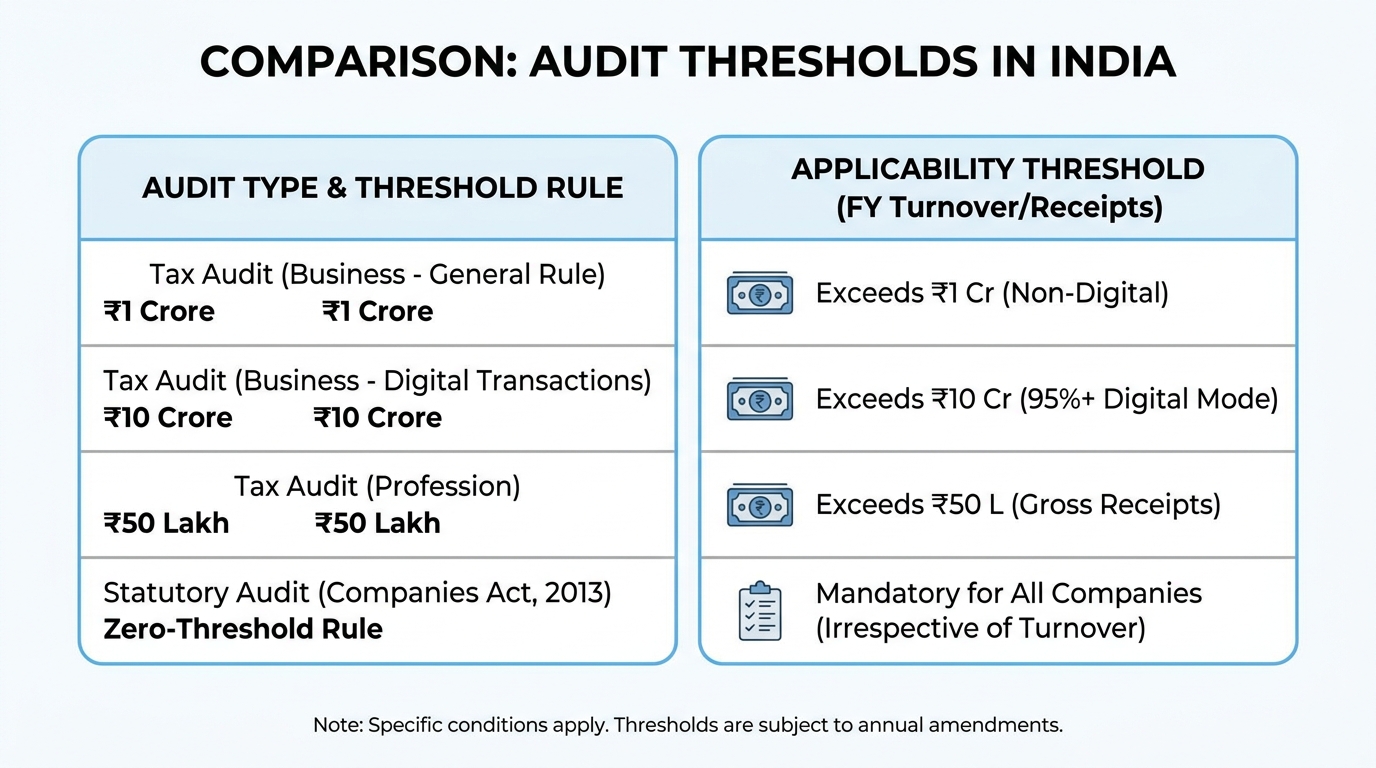
You must undergo a tax audit if you cross these specific thresholds:
- For Businesses: A tax audit is mandatory when your total sales, turnover, or gross receipts exceed ₹1 crore in a financial year.
- The Digital Exemption: To promote a cashless economy, the government raised the business turnover threshold to ₹10 crore, provided that your cash receipts and cash payments are limited to 5% or less of your total transactions (meaning 95% of your business is digital).
- For Professionals: Doctors, lawyers, architects, and freelance professionals must undergo a tax audit if their gross receipts exceed ₹50 lakhs in a financial year.
A Note on GST Audits
Historically, businesses also faced a mandatory GST audit by a CA. However, the government removed this requirement. Today, if your aggregate turnover exceeds ₹5 crore, you only need to submit a self-certified reconciliation statement (Form GSTR-9C) alongside your annual return.
What Does the Auditor Actually Check?
Business owners often worry about the audit process. Your Chartered Accountant is not there to interfere with your business model; they are there to verify the accuracy of your financial claims. Rather than getting bogged down in complex CA-level procedures, here is exactly what the auditor will examine:
- Books of Accounts: Verifying that ledgers, journal entries, and cash books match your bank statements.
- GST Compliance: Checking that input tax credits (ITC) are claimed correctly and match your GSTR-2B.
- Depreciation Calculations: Ensuring asset depreciation follows the specific rates defined by the Companies Act and Income Tax Act.
- Debtors and Creditors: Confirming that the outstanding balances shown in your balance sheet are accurate and recoverable.
- Related-Party Transactions: Scrutinizing loans or payments made to directors, family members, or sister concerns to ensure fair market value.
Pro Tip: Keep digital copies of all vendor invoices and bank statements organized by month. Companies that maintain clean, month-to-month digital records finish their statutory audits 50% faster than those who scramble at year-end.
Penalties for Missing Audit Deadlines
Failing to comply with audit requirements results in severe financial and legal repercussions. The penalties differ depending on the type of audit you miss.
For missing a tax audit, Section 271B of the Income Tax Act imposes a strict penalty. You will be fined 0.5% of your total sales/turnover, or ₹1,50,000—whichever amount is lower.
For missing a statutory audit, the penalties fall under the Companies Act. The company can face fines ranging from ₹25,000 to ₹5,00,000. Furthermore, the company’s directors are considered “officers in default” and may face personal fines or even imprisonment for severe negligence.
Common Mistakes in Statutory and Tax Audits
Even well-intentioned founders make compliance errors. Avoid these frequent pitfalls:
- Confusing statutory and tax audits: Believing that because your revenue is under ₹1 crore, you do not need any audit at all. Remember, Private Limited companies always need a statutory audit.
- Miscalculating the 5% cash limit: Assuming you qualify for the ₹10 crore tax audit threshold without strictly verifying that your cash payments (including petty cash) stayed below the 5% legal limit.
- Delaying book closures: Waiting until September to close the financial books. This leaves no time for the auditor to resolve discrepancies before the strict filing deadlines.
Frequently Asked Questions
Is statutory audit mandatory for a small company?
Yes, a statutory audit is mandatory for all small companies registered under the Companies Act. Even if your turnover is zero or your company is currently inactive, an audit by an ICAI-registered Chartered Accountant is legally required annually.
What is the turnover limit for tax audit in India?
Under Section 44AB, the base turnover limit for a business tax audit is ₹1 crore. However, this limit extends to ₹10 crore if 95% of your total receipts and payments are processed digitally. For professionals, the limit is ₹50 lakhs.
What is the difference between statutory audit and tax audit?
A statutory audit ensures compliance with the Companies Act and is mandatory for all registered companies regardless of revenue. A tax audit ensures compliance with the Income Tax Act and is only mandatory when your business or professional revenue crosses specific financial thresholds.
When is the deadline for submitting an audit report?
Tax audit reports must generally be submitted by September 30th of the assessment year. Statutory audits must be completed and presented to shareholders before the company’s Annual General Meeting (AGM), which is also typically held by September 30th.
Can the same CA do both statutory and tax audit?
Yes, the same ICAI-registered Chartered Accountant can perform both the statutory audit and the tax audit for your company. Using the same professional streamlines your compliance process and reduces repetitive document requests.
Conclusion
Understanding when is a statutory audit mandatory in India protects your business from unnecessary fines and legal headaches. To recap: if you operate a registered company, you need a statutory audit regardless of your revenue. If your business scales past ₹1 crore (or ₹10 crore digitally) or your professional income exceeds ₹50 lakhs, you must also prepare for a tax audit under Section 44AB.