

TL;DR: ROC compliance requires Indian companies to submit annual financial and operational reports to the Ministry of Corporate Affairs. Missing deadlines for crucial forms like AOC-4, MGT-7/7A triggers a strict ₹100/day penalty per form. Timely filing ensures legal standing, avoids compounded fines, and keeps directors compliant.
Introduction
Running a Private Limited (Pvt Ltd) company or Limited Liability Partnership (LLP) in India means navigating strict regulatory frameworks. Every incorporated entity must comply—there are no exceptions. Many founders focus entirely on business growth, treating regulatory paperwork as an afterthought until massive late fees accumulate.
Whether you are a newly registered startup or an established enterprise, mastering ROC compliances is non-negotiable. This complete guide breaks down exactly what forms you need to file, when they are due, and how to protect your company’s legal standing while avoiding severe financial penalties.
What are ROC Compliances?
ROC compliances refers to the mandatory annual and event-based filings every company must submit to the Ministry of Corporate Affairs (MCA). It legally records a company’s financial statements, shareholder details, and board operations, ensuring corporate transparency and accountability under the Companies Act, 2013.
Why Timely Filing Matters
Staying compliant is not just about avoiding fines; it is about maintaining your company’s right to operate. Banks require up-to-date ROC filings to approve corporate loans or extend credit lines. Investors mandate clean compliance records during due diligence before injecting capital. Furthermore, consistent non-compliance for a period of 5 years can lead to the MCA suo moto striking your company off the official register, effectively freezing your bank accounts and halting business operations.
Mandatory Annual Filings and Deadlines
Every Private Limited company must submit core annual documents to the Registrar of Companies. Missing these dates triggers immediate penalties.
1. Form AOC-4 (Financial Statements)
Form AOC-4 contains your company’s balance sheet, profit and loss account, and the directors’ report. It must be filed within 30 days of your Annual General Meeting (AGM). Because the standard deadline for holding an AGM is September 30, the AOC-4 filing deadline firmly lands on October 30 of the relevant assessment year.
2. Form MGT-7 (Annual Return)
Form MGT-7 is your company’s annual operational return. It details your shareholding structure, registered office address, and any changes in directorship. This form must be filed within 60 days from the AGM date, which typically makes the deadline November 29.
3. Form DPT-3 (Return of Deposits)
Form DPT-3 is an annual return that reports your company’s outstanding money received as loans or other amounts that are not treated as deposits under the Companies Act, 2013. Every company, except Government companies, must file this return each year. The due date for filing Form DPT-3 is June 30 for the financial year ending on March 31.
4. DIR-3 KYC (Director Verification)
Every individual holding a Director Identification Number (DIN) must complete their KYC annually. This process confirms the director’s current phone number, email address, and residential status. The hard deadline for DIR-3 KYC is June 30 every 3 years since the date of last DIR-3 KYC.
5. MSME-1 (Outstanding Payment to MSMEs)
Form MSME-1 is a half-yearly return that reports payments due to Micro and Small Enterprises remaining unpaid for more than 45 days from the date of acceptance or deemed acceptance of goods or services. Companies meeting the prescribed criteria must file this return twice a year, with due dates of April 30 and October 31..
Annual Compliance Summary Table
| Form | Purpose | Due Date | Late Penalty |
|---|---|---|---|
| AOC-4 | Financial Statements | October 30 | ₹100 / day |
| MGT-7/7A | Annual Return | 60 days post-AGM | ₹100 / day |
| DIR-3 KYC | Director Verification | September 30 | ₹5,000 fixed fee |
Pro Tip: Do not wait until the last week of September to hold your AGM. Holding the meeting in August gives your auditors and company secretaries a comfortable buffer to prepare and upload AOC-4 and MGT-7 without rushing.
Essential One-Time Compliances
Beyond annual filings, newly incorporated companies must complete specific initial compliances to activate their legal operating status.
Form INC-20A (Commencement of Business)
A newly registered company cannot legally start business operations or borrow money until it files Form INC-20A. You must deposit the initial subscriber capital into the corporate bank account and file this form within 180 days of incorporation. Failure to do so gives the ROC grounds to strike the company from the register.
Form INC-22 (Registered Office Address)
If you incorporated your company with a temporary address, you must establish a permanent registered office and file Form INC-22 within 30 days of incorporation. This ensures the MCA has a verified location for all official corporate correspondence.
Form ADT-1 (Appointment of Auditor)
Form ADT-1 is used to notify the Registrar of Companies about the appointment or reappointment of a statutory auditor. It must be filed within 15 days of the auditor’s appointment at the Annual General Meeting or Board Meeting in accordance with the provisions of the Companies Act, 2013. An Auditor is usually appointed in an Annual General Meeting, however the Board of Directors of a newly incorporated company must appoint a statutory auditor for a period of 1 year within 30 days of incorporation.
Form BEN-2 (Significant Beneficial Ownership) (If Applicable)
Form BEN-2 is filed to disclose the details of individuals who are Significant Beneficial Owners (SBOs) in a company, ensuring transparency in the ownership and control of corporate entities. Every company that receives a declaration in Form BEN-1 from an individual who holds significant beneficial ownership—whether directly or indirectly—is required to file Form BEN-2 with the Registrar of Companies. The form must be filed within 30 days of receiving the BEN-1 declaration.
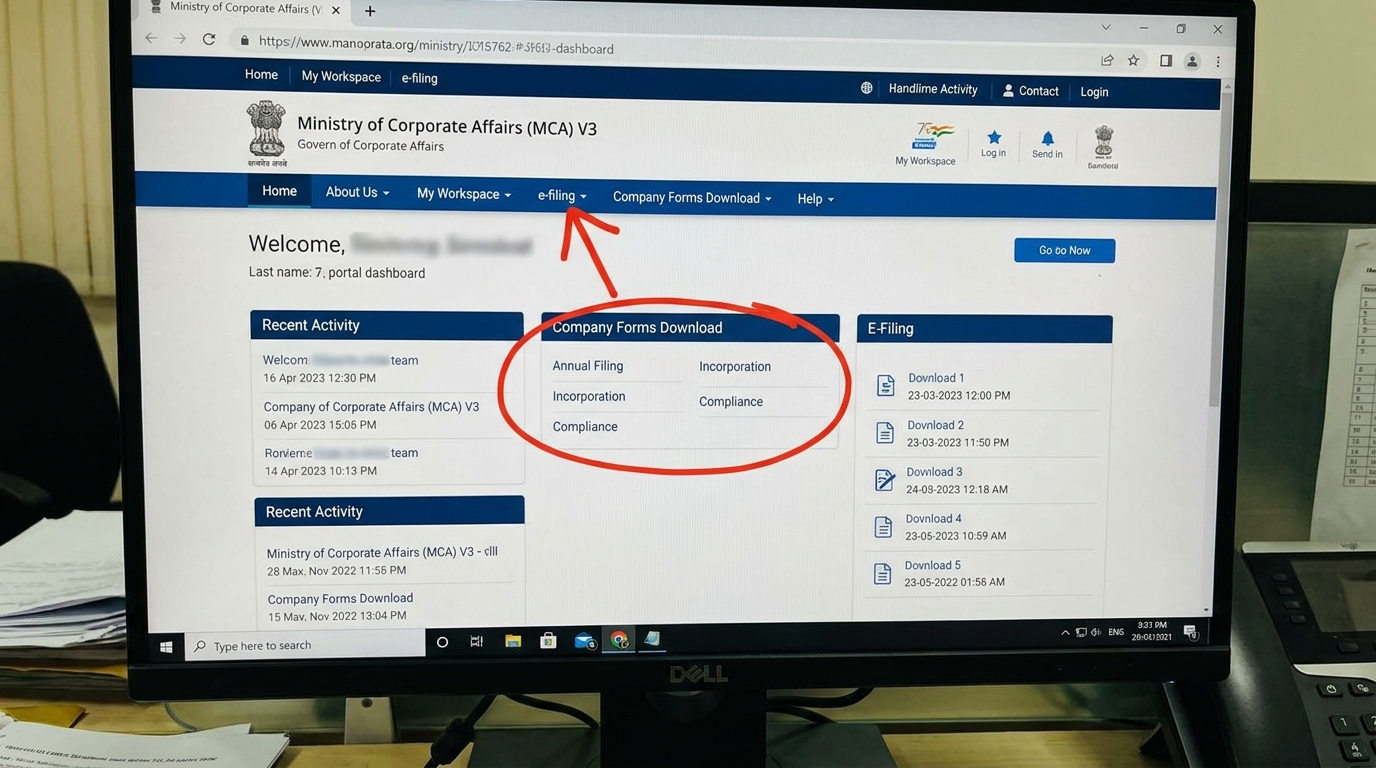
The True Cost of Late Filing (Penalty Example)
The most critical aspect of ROC compliances is understanding the compounding nature of late fees. The MCA does not grant leniency for forgotten deadlines. Under the Companies Act, 2013, the penalty for late filing of forms like AOC-4 and MGT-7/7A is a flat ₹100 per day, per form.
This may sound manageable, but it compounds aggressively. Consider a scenario where a company forgets to file its returns and realizes the mistake six months (180 days) late:
- AOC-4 Penalty: 180 days × ₹100 = ₹18,000
- MGT-7 Penalty: 180 days × ₹100 = ₹18,000
- Total Late Fee: ₹36,000
This ₹36,000 is purely the late fee—it does not include the standard government filing fees or professional charges to rectify the default.
Key insight: Over 200,000 Indian companies were struck off the register in recent years purely due to continuous failure in filing annual returns, highlighting the MCA’s strict zero-tolerance enforcement (Ministry of Corporate Affairs, 2023).
Common Compliance Mistakes
- Ignoring Dormant Companies: Founders often assume that if a company had zero revenue or no transactions, filing is not required. Every registered entity must file “Nil” returns to remain active.
- Missing Director KYC: Forgetting the September 30 deadline for DIR-3 KYC results in immediate deactivation of the DIN and a flat ₹5,000 penalty to reactivate it.
- Mixing up LLP and Pvt Ltd Rules: LLPs do not file AOC-4 or MGT-7. Instead, they must file Form 11 by May 30 and Form 8 by October 30. Applying Pvt Ltd deadlines to an LLP guarantees compliance failure. <To know more>
Frequently Asked Questions
What are ROC compliances for a Pvt Ltd company?
It is the mandatory submission of financial and operational reports to the Ministry of Corporate Affairs. For a Private Limited company, this primarily includes filing Form AOC-4 for financial statements and MGT-7 for the annual return to maintain active legal status.
What is the penalty for late ROC filing?
The penalty for late ROC filing is a strict ₹100 per day for each delayed form. This late fee begins accruing immediately after the deadline passes and continues indefinitely. For directors, severe delays can lead to DIN deactivation and disqualification.
Are ROC compliances required for a dormant company?
Yes, a dormant company must still fulfill annual ROC compliances to retain its status. You must file Form MSC-3 (Return of Dormant Company) within 30 days of the financial year ending. Failing to file this can result in the company being struck off.
What is Form AOC-4 and MGT-7?
Form AOC-4 is used to file a company’s annual financial statements, including the balance sheet and profit and loss account. Form MGT-7 serves as the annual operational return, detailing the company’s shareholding structure, directorship changes, and registered office details.
Does an LLP need to file ROC compliances?
Yes, a Limited Liability Partnership (LLP) must file annual compliances, though the forms differ from private companies. An LLP must file Form 11 (Annual Return) by May 30 and Form 8 (Statement of Account & Solvency) by October 30 every year. <To know more>
Conclusion
Maintaining precise ROC compliance is a foundational responsibility of every company founder in India. From the rigorous October 30 deadline for AOC-4 to the critical 180-day window for INC-20A, understanding these requirements protects your company from compounding ₹100/day penalties and severe legal restrictions. Treat your annual filings not as a burden, but as a crucial pillar of your company’s operational health.