
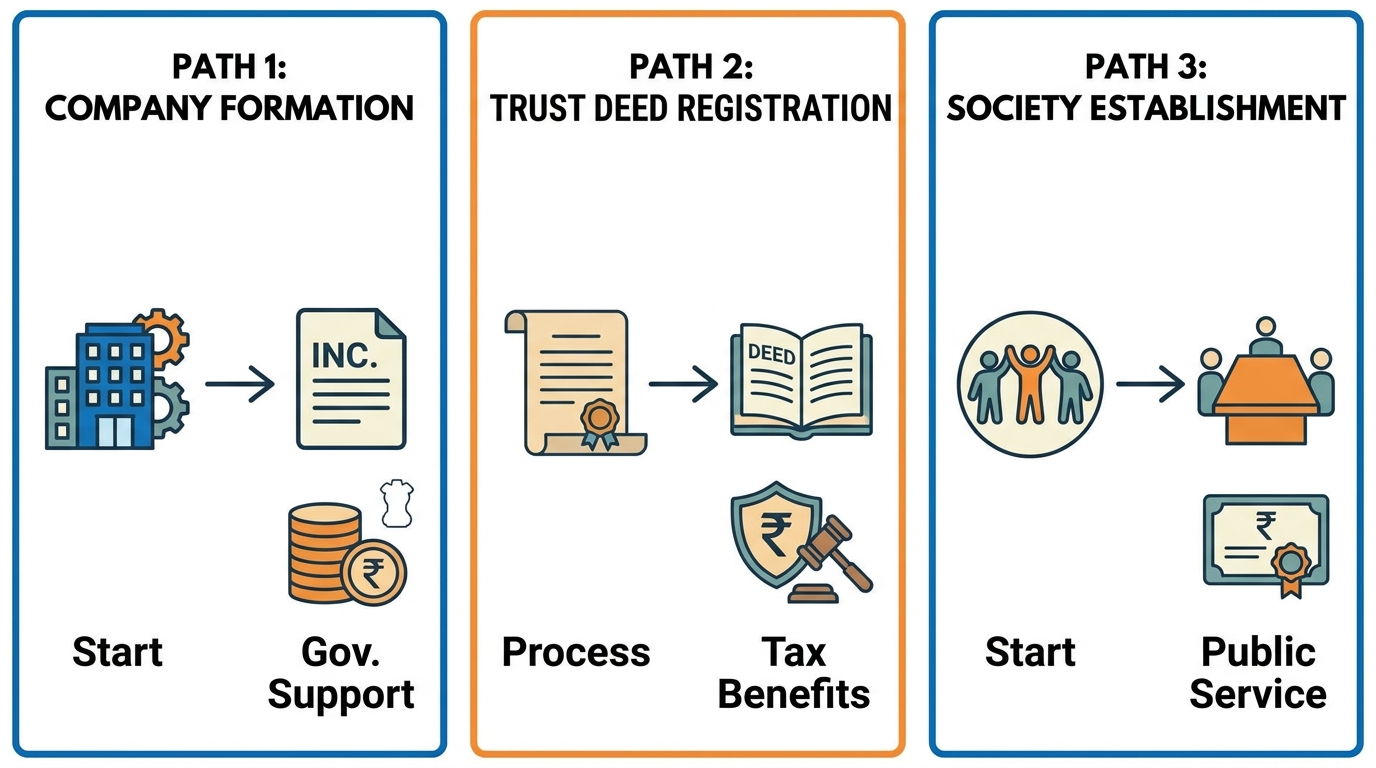
TL;DR: In India, “NGO” is not a legal structure, it is a general label people use for any non-profit. The real legal options are Section 8 company, public charitable trust, and registered society, each with different costs, compliance loads, and fundraising eligibility. Section 8 companies win on credibility and CSR funding, trusts win on low cost and simplicity, and societies suit membership-driven welfare or educational work.
Introduction
If you are planning to start a social enterprise in India, you have probably searched for “how to register an NGO” and landed on three confusing options: Section 8 company, trust, and society. Here is the first thing to understand: NGO is not a legal term in Indian law. It is a colloquial, catch-all phrase for any organization working on a social cause, similar to how people say “startup” without meaning a specific legal entity.
The actual legal structures available under Indian law are the Section 8 company (Companies Act, 2013), the public charitable trust (state-specific Trusts Acts), and the registered society (Societies Registration Act, 1860). Each one governs your organization differently, affects how much tax benefit you get, decides whether you can legally earn revenue, and determines your eligibility for foreign funding under the Foreign Contribution Regulation Act (FCRA).
This guide is for founders, social entrepreneurs, and trustees who need to pick one structure before registration, not after. We will break down all three options, compare them on six practical dimensions, and give you a simple “choose this if” decision matrix at the end.
What Is a Section 8 Company, Trust, and Society?
A Section 8 company is a non-profit entity registered under the Companies Act, 2013, that can conduct commercial activities as long as profits are reinvested in its social mission. A public charitable trust is formed through a trust deed and registered under state trust laws, focused purely on philanthropic work. A registered society is a membership-based body registered under the Societies Registration Act, 1860, commonly used for education and community welfare.
Why This Decision Matters
Picking the wrong structure early can cost you later. Changing from a trust to a Section 8 company, or vice versa, is legally complex, time-consuming, and sometimes impossible without dissolving and reforming the entity.
Key insight: Section 8 companies are increasingly preferred by corporate CSR teams because the Companies Act governance framework gives donors more confidence in financial accountability compared to trusts, which have looser oversight in several states.
Your choice affects three things founders often underestimate:
- Fundraising ability: Corporate CSR desks, institutional donors, and international funders each have preferences based on legal structure.
- Compliance burden: Annual filings range from minimal (trust) to extensive (Section 8 company with ROC filings).
- Revenue flexibility: Only Section 8 companies are explicitly built to combine commercial activity with social mission.
Section 8 Company: The Corporate-Style Non-Profit
A Section 8 company is registered under the Companies Act, 2013, and functions much like a private limited company, minus the ability to distribute profits to shareholders. It requires a minimum of two directors, a registered office, and compliance with the Ministry of Corporate Affairs (MCA).
Key features:
- Can legally conduct commercial or revenue-generating activities to fund its social objectives
- Eligible for 80G (donor tax deduction) and 12A (income tax exemption) registrations
- Preferred structure for CSR funding from large corporations because of stricter governance and audit norms
- Requires ROC (Registrar of Companies) annual filings, board meetings, and statutory audits
Pro Tip: If you plan to raise CSR funds from listed companies in your first two years, register as a Section 8 company from day one. Converting from a trust later means restarting most donor due-diligence processes.
Public Charitable Trust: The Simplest Path
A public charitable trust is created through a trust deed, a legal document that names trustees, states the charitable objective, and lists trust property. Registration happens with the local Sub-Registrar under the applicable state Trusts Act.
- Cheapest and fastest to set up, often needing just two trustees and a notarized deed
- Best suited for purely philanthropic work like relief funds, scholarships, or religious charity
- Eligible for FCRA registration to receive foreign donations, once it completes three years of existence and meets eligibility norms
- Governance is less standardized since trust laws vary by state
Trusts work well for founders who want to start small, keep costs low, and are not planning large-scale commercial revenue streams alongside their charitable work.
Registered Society: The Membership Model
A registered society is formed under the Societies Registration Act, 1860, by a minimum of seven members (in most states) who adopt a memorandum of association and rules and regulations. It is governed democratically through a managing committee elected by members.
Key features:
- Common structure for schools, colleges, hospitals, and welfare associations
- Requires periodic elections and general body meetings, giving members more control than a trust structure
- Can apply for 80G, 12A, and FCRA registration like the other two structures
- Compliance requirements vary significantly by state, since registration is state-specific
Societies suit organizations where community ownership and democratic decision-making matter more than centralized control.
Section 8 Company vs Trust vs Society: 6-Point Comparison
| Dimension | Section 8 Company | Public Charitable Trust | Registered Society |
|---|---|---|---|
| Formation cost | Highest (₹15,000-30,000+ typical) | Lowest (₹5,000-10,000 typical) | Moderate (₹8,000-15,000 typical) |
| Governing law | Companies Act, 2013 | State Trusts Acts | Societies Registration Act, 1860 |
| Compliance burden | Highest (ROC filings, audits, board meetings) | Lowest (minimal state-level filings) | Moderate (annual general meetings, state filings) |
| Revenue-generating activity | Explicitly allowed for mission funding | Limited, mainly donation-based | Limited, membership fees and grants |
| CSR fund eligibility | Most preferred by corporate donors | Accepted but less preferred | Accepted, common for institutional projects |
| FCRA eligibility | Yes, after 3 years of existence | Yes, after 3 years of existence | Yes, after 3 years of existence |
All three structures can apply for 80G and 12A tax registrations, and all three become eligible for FCRA registration once they meet the standard three-year existence requirement and other Ministry of Home Affairs conditions.
Common Mistakes Founders Make
Registering as a trust and then trying to run a commercial arm. Trusts generally have lesser flexibility for revenue-generating activites in comparision to Section 8 Companies; this causes tax and compliance headaches later.
Assuming “NGO” registration exists as a single process. There is no such thing as generic NGO registration. You must pick Section 8 company, trust, or society specifically, then separately apply for 80G, 12A, and FCRA as needed.
Ignoring state variation for trusts and societies. Trust and society laws differ by state, so a process that works in Maharashtra may not match requirements in Delhi or Karnataka.
Underestimating Section 8 compliance costs. Founders often pick Section 8 for credibility but do not budget for the ongoing ROC filings, audits, and board governance this structure demands.
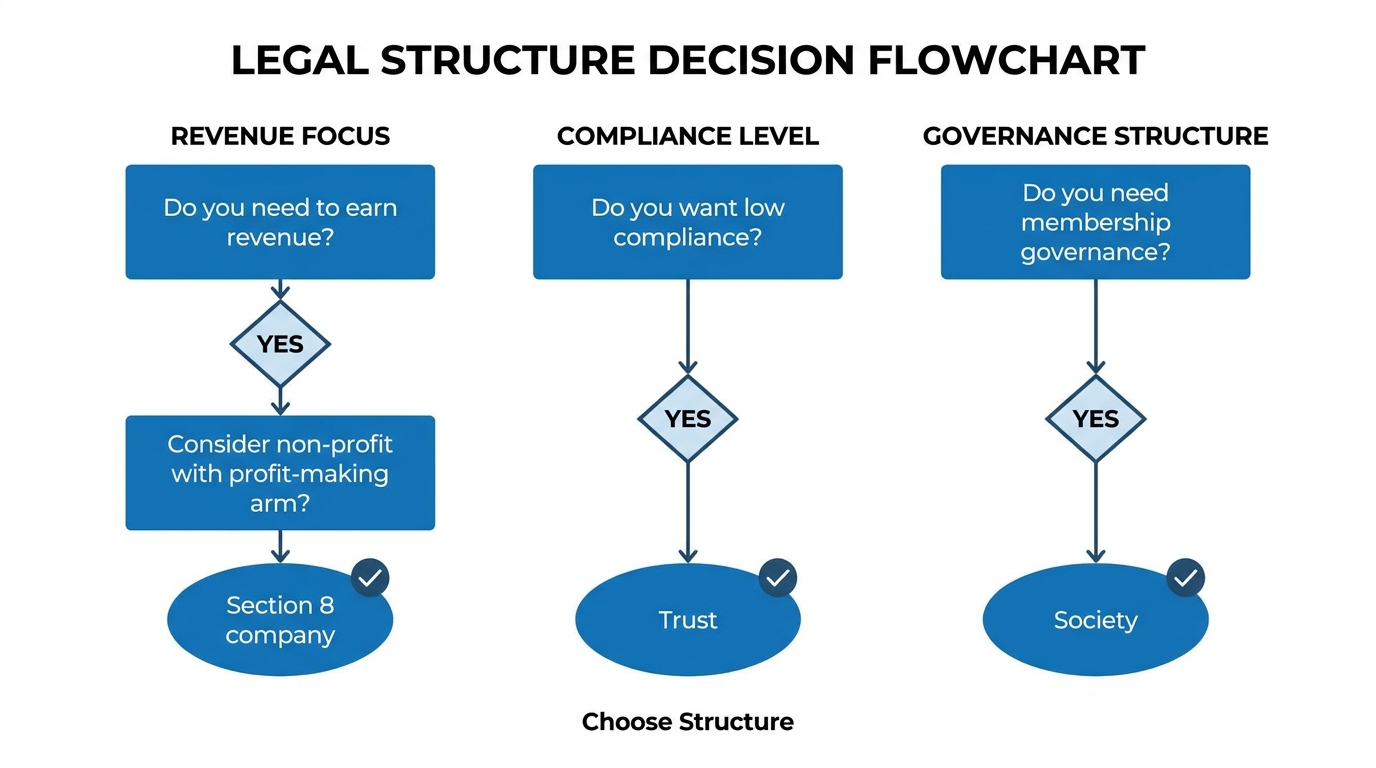
Choose Section 8, Trust, or Society: The Decision Matrix
Use this quick matrix based on your primary goal:
- Choose Section 8 company if: You plan to combine commercial revenue with social impact, you want to attract CSR funds from large corporations, or you want the highest institutional credibility.
- Choose a public charitable trust if: You want the fastest, cheapest registration, your work is purely donation-funded, or you are running a small-scale charitable initiative without commercial ambitions.
- Choose a registered society if: You are building an educational institution, welfare association, or community project that benefits from democratic, membership-based governance.
Frequently Asked Questions
What is the difference between Section 8 company and NGO?NGO is not a legal term in India, it is a general label for any non-profit organization. A Section 8 company is one of three actual legal structures (along with trust and society) that non-profits can register under the Companies Act, 2013.
Can a Section 8 company earn revenue?Yes, a Section 8 company can legally conduct commercial activities. The key condition is that all profits must be reinvested into the organization’s stated social objectives, not distributed to members or directors.
Which structure is best for receiving CSR funds?Section 8 companies are generally preferred for CSR funding because their governance under the Companies Act gives corporate donors more confidence in financial oversight. Trusts and societies can still receive CSR funds but often face more scrutiny during due diligence.
What is 80G registration for non-profits?80G is an income tax registration that lets donors claim a tax deduction on donations made to your organization. All three structures, Section 8 company, trust, and society, can apply for 80G once they meet Income Tax Department eligibility conditions.
Can a trust receive foreign donations under FCRA?Yes, a public charitable trust can apply for FCRA registration to receive foreign contributions. It typically needs at least three years of existence and must meet other Ministry of Home Affairs eligibility criteria, the same requirement that applies to Section 8 companies and societies.
Conclusion
Choosing between a Section 8 company, trust, and society comes down to your funding plans, compliance capacity, and governance style. There is no universal “NGO” registration, only these three distinct legal paths, each with different rules on cost, tax benefits, and revenue generation. If you want commercial flexibility and CSR credibility, go with a Section 8 company. If you want speed and simplicity for purely charitable work, a trust is your best bet. If community governance matters most, a registered society fits.
Before you file any paperwork, get your structure reviewed by a professional who understands both the legal and fundraising implications.