
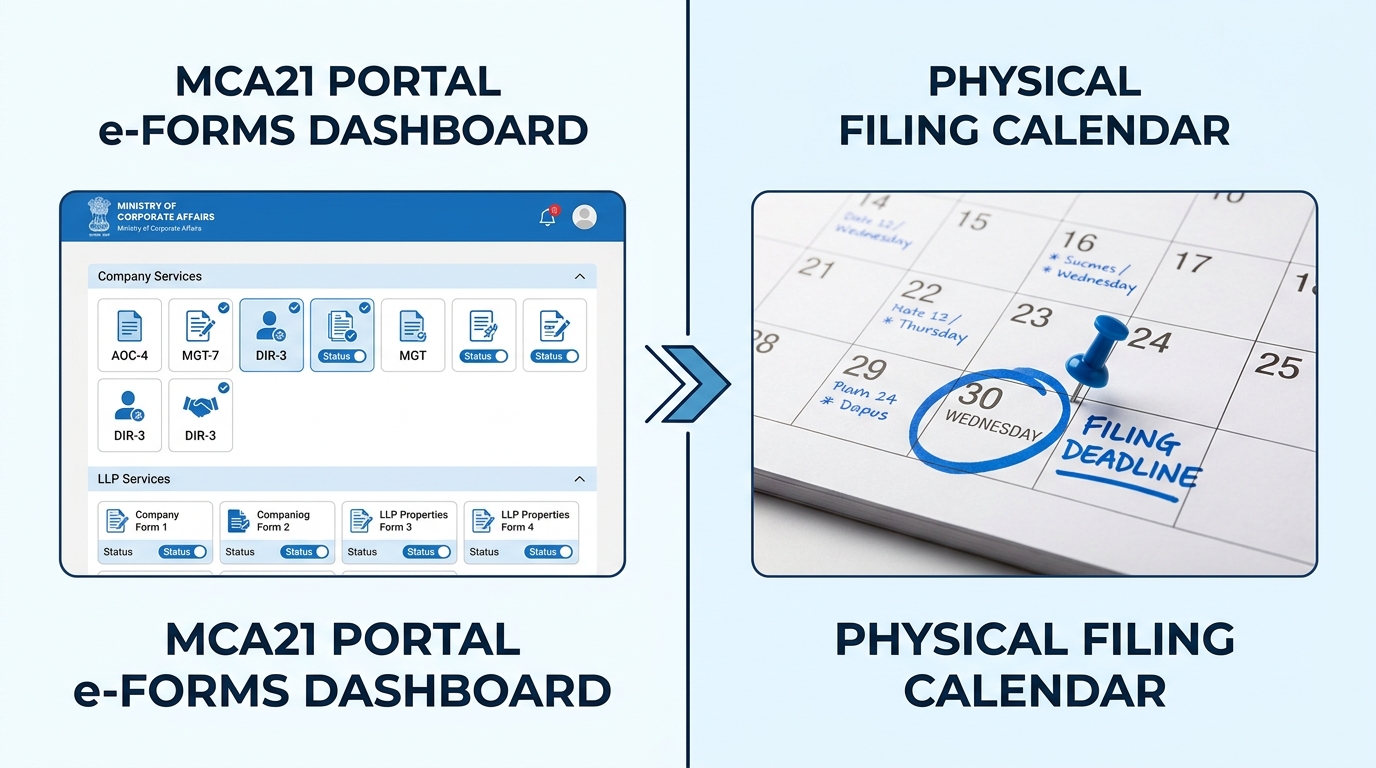
 TL;DR: Every company registered under the provisions of the Companies Act, 2013 must file AOC-4 (financial statements) by October 30 and MGT-7 (annual return) within 60 days of the AGM. Missing either deadline costs ₹100 per day per form with no upper cap, and most rejections happen due to wrong financial year selection, DSC mismatch, or missing board resolution attachments.
Every Pvt Ltd company registered in India must file two annual forms with the Registrar of Companies (ROC): AOC-4, which carries the financial statements and board’s report, due by October 30, and MGT-7, the annual return with shareholding pattern, due 60 days from the Annual General Meeting (AGM) date. Miss either one and the penalty clock starts ticking immediately at ₹100 per day, per form, with no maximum limit.
This guide is built for company directors and CA associates who handle ROC annual filing on a recurring basis. It skips the textbook explanations and goes straight into what each form contains, exact due dates, the MCA21 portal workflow, and the specific errors that get filings rejected. If you’ve ever had a filing bounce back with a cryptic error code, the last section covers exactly why that happens.
What Is ROC Annual Filing?
ROC annual filing is the yearly compliance process where companies submit their financial statements and annual return to the Ministry of Corporate Affairs (MCA) through Forms AOC-4 and MGT-7. It applies to every registered company in India, private or public, regardless of turnover or activity status. Filing is mandatory even for companies with zero revenue in a given year.
Why ROC Annual Filing Matters
Missing ROC annual filing deadlines doesn’t just mean a late fee. Directors of companies that fail to file for three consecutive years can be disqualified under Section 164(2) of the Companies Act, 2013, and barred from being appointed as directors in any other company for five years. The company itself risks being marked as a defaulting company on the MCA portal, which affects bank loan approvals, vendor contracts, and due diligence during fundraising.
Key insight: A company with zero business activity still owes ₹100/day per form if AOC-4 or MGT-7 is filed late, since the penalty is tied to the delay, not the company’s turnover.
AOC-4: Contents, Due Date, and Filing Requirements
Form AOC-4 is the vehicle for submitting a company’s financial statements to the ROC each year.
What AOC-4 Contains
- Balance sheet as at the end of the financial year
- Profit and loss account (or income and expenditure account for non-profit companies)
- Auditor’s report signed by the statutory auditor
- Board’s report with mandatory disclosures including related party transactions, CSR spending (if applicable), and details of loans, guarantees, or investments
- Cash flow statement, if applicable to the company category
- Notes to accounts and schedules
AOC-4 Due Date
AOC-4 is due within 30 days of the AGM, but practically capped at October 30 or 180 days from the end of the financial year, whichever is earlier. For companies with a financial year ending March 31, this means the AGM must happen by September 30, and AOC-4 follows within 30 days.
AOC-4 Late Fee
The additional fee for late filing of AOC-4 is ₹100 per day, calculated from the due date until the actual filing date. There is no cap, so a 90-day delay costs ₹9,000 in additional fees alone, on top of the normal filing fee.
Pro Tip: File AOC-4 at least 3-4 days before October 30. The MCA portal often slows down in the last week of October due to volume, and a failed upload attempt on the deadline day still counts as late.
MGT-7: Contents, Due Date, and Signing Requirements
Form MGT-7 is the annual return that captures a company’s structural and ownership details as they stood at the end of the financial year.
What MGT-7 Contains
-
Shareholding structure, including changes in shareholding during the year
-
Details of directors and key managerial personnel (KMP), including appointments and resignations
-
Indebtedness of the company, covering secured and unsecured loans
-
Details of members and debenture holders
-
Promoter shareholding pattern
-
Meetings held during the year, including board meetings and the AGM
-
Certification of Annual Return (MGT-8), Form MGT-8 is mandatory for listed companies and any company with a paid-up capital of ₹10 crore+ or turnover of ₹50 crore+.
Note that small companies and one-person companies (OPCs) file a simplified version called MGT-7A instead.
MGT-7 Due Date
MGT-7 must be filed within 60 days from the date of the AGM. If the AGM is held on September 30, MGT-7 is due by November 29. Unlike AOC-4, this deadline is not tied to a fixed calendar date since it depends entirely on when the AGM actually took place.
Who Signs MGT-7
MGT-7 must be certified by a Company Secretary (CS) in practice. If the company does not have a whole-time CS, a practicing CA can certify the form instead, provided the company falls under the category permitted to use this alternative under the Companies Act rules.
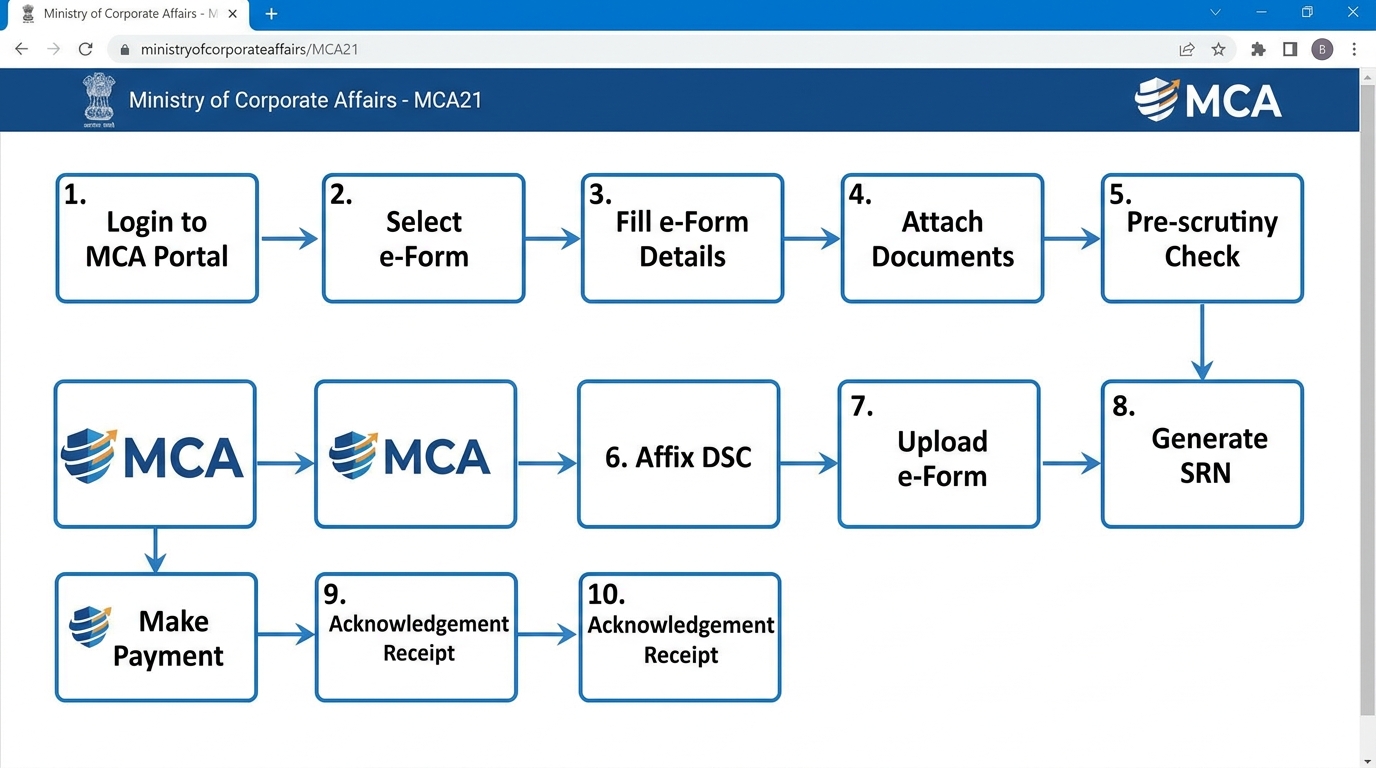
MCA21 Portal Filing Process: Step by Step
Here’s the practical workflow for filing both forms on the MCA21 portal.
- Log in to the MCA21 portal using your registered credentials at mca.gov.in.
- Navigate to Company Services from the main dashboard menu.
- Select “e-Forms” and search for the specific form (AOC-4 or MGT-7) from the form list.
- Fill in company details, including CIN, financial year, and AGM date (for MGT-7).
- Enter financial and structural data as applicable, pulling figures directly from the audited financials or the register of members.
- Validate the form using the “Check Form” button before proceeding. This catches basic field errors early.
- Attach required documents: audited balance sheet, P&L, auditor’s report, and board’s report for AOC-4; list of shareholders and MGT-9 extract (if applicable) for MGT-7.
- Affix the Digital Signature Certificate (DSC) of the authorized director and the certifying professional (CA or CS).
- Upload the form through the “Upload eForm” section.
- Generate the SRN (Service Request Number) and complete payment of filing fees and any applicable late fee.
Keep the SRN and payment receipt saved separately from the MCA portal records, since it’s the primary reference for tracking the filing status or resolving disputes later.
Common Errors That Cause Rejection
Most AOC-4 and MGT-7 rejections trace back to a handful of repeat mistakes.
| Error | Why It Happens | How to Avoid It |
|---|---|---|
| Wrong financial year selected | Form defaults or copy-paste from previous filing | Double-check the FY dropdown before validation |
| DSC mismatch | DSC registered doesn’t match the authorized signatory on record | Verify DSC registration on MCA portal before filing season |
| Missing board resolution attachment | Filer assumes it’s optional for standard filings | Always attach the board resolution approving financial statements |
| Incorrect SRN for previous year linking | Manual entry error when the form asks for prior year’s SRN | Cross-check SRN from last year’s payment receipt, not memory |
| Auditor’s UDIN not updated | Filed before auditor generates UDIN on financial statements | Confirm UDIN generation before starting the e-Form |
Pro Tip: Keep a shared checklist for every client or company you file for, listing DSC expiry dates, last year’s SRN, and auditor UDIN status. Most last-minute rejections happen because this information wasn’t verified before the filing session started.
Frequently Asked Questions
What is Form AOC-4 and when is it due?Form AOC-4 is the annual filing that submits a company’s financial statements, board’s report, and auditor’s report to the ROC. It is due by October 30 or 180 days from the financial year end (only for OPCs), whichever is earlier, for most companies with a March 31 year-end.
What is the MGT-7 annual return?MGT-7 is the annual return form that reports a company’s shareholding pattern, director details, and indebtedness as of the financial year-end. It must be filed within 60 days from the date the AGM was held, and small companies use the simplified MGT-7A version instead.
What is the penalty for late filing of AOC-4?The penalty for late filing of AOC-4 is ₹100 per day from the due date until the actual filing date, with no upper cap. A delay of even a few weeks can add up to a significant additional fee on top of the standard filing cost.
Do I need a company secretary to file MGT-7?MGT-7 must be certified by a practicing Company Secretary in most cases. If the company doesn’t have a whole-time CS on staff, a practicing Chartered Accountant can certify the form instead, subject to the company’s eligibility under the Companies Act rules.
Can the same CA file both AOC-4 and MGT-7?Yes, the same CA can handle both filings, but the certification role differs. A CA typically certifies AOC-4 as the statutory auditor, while for MGT-7, a CA can certify only if the company qualifies for the CS exemption under applicable rules.
Conclusion
ROC annual filing through AOC-4 and MGT-7 isn’t optional paperwork, it’s a legal requirement with real financial and compliance consequences for missed deadlines. AOC-4 covers your financial statements and is due 30 days from the AGM, while MGT-7 covers your annual return and is due 60 days from the AGM, both carrying a ₹100 per day late fee with no cap. The forms themselves aren’t complicated, but the recurring rejection reasons, wrong financial years, DSC mismatches, and missing attachments, are entirely avoidable with a proper pre-filing checklist.