Introduction
In several instances, taxpayers—due to lack of clarity—paid GST against demand orders through Form GST DRC-03, without realizing that this form is only meant for voluntary payment of tax. As per the GST law, tax liability created from any order must be paid by debiting the Electronic Liability Ledger.
Because these payments made through Form GST DRC-03 were not linked to the specific demand in the Electronic Liability Ledger, they were not automatically appropriated against the demand. This left taxpayers with no option but to approach GST authorities to rectify the situation. However, the GST framework did not permit appropriation of voluntary payments against demands created through adjudication orders.
Introduction of Form GST DRC-03A
To address this procedural gap, the issue was raised before the GST Council, which led to the introduction of Form GST DRC-03A.
The department clarified that any payment made via Form GST DRC-03, for which no DRC-05 order has been issued, can be appropriated against the demand liability by filing Form GST DRC-03A.
Steps to File Form GST DRC-03A
Open Form GST DRC-03A.
Provide the ARN of the previously filed Form GST DRC-03 through which payment was made.
The form will auto-populate the payment details from Form GST DRC-03.
Enter the reference number of the demand order (including rectification or appeal orders) against which the payment was intended.
The corresponding demand details will auto-populate in the form.
Complete the undertaking and verification sections.
File the form using DSC or EVC.
Once Form GST DRC-03A is filed, the demand liability is treated as paid to the extent of the amount earlier paid via DRC-03. This is a significant relief to taxpayers who previously had no remedy for such errors.
Purpose and Position of DRC-03A in GST Compliance
Form GST DRC-03A now functions as a gateway to reconcile and link two separate modes of payment:
Voluntary payments via Form GST DRC-03, and
Statutory demands recorded in the Electronic Liability Ledger.
By enabling appropriation, the form effectively addresses a long-standing procedural bottleneck in the GST framework.
DRC-03A and Pre-deposit for GST Appellate Tribunal
Another important use case of Form GST DRC-03A is in the context of pre-deposit payments prior to filing an appeal before the yet-to-be-constituted GST Appellate Tribunal.
While the legal validity of this circular can be debated—given that the Tribunal remains non-operational even after 7 years of GST implementation—the procedure for pre-deposit is laid out clearly.
When a taxpayer is aggrieved by the order passed by the Appellate Authority, the law provides for filing an appeal before the Appellate Tribunal. However, as this Tribunal is still not constituted, taxpayers are being denied the remedy of appeal.
Meanwhile, field officers are pursuing recovery of such disputed demands, creating a highly unfair and impossible situation for affected taxpayers.
Department Clarification on Pre-deposit Payment
To resolve this, the department issued a clarification stating:
For those who have not yet paid the 20% pre-deposit:
The taxpayer should pay 20% of the disputed tax demand against the liability recorded in the Electronic Liability Ledger.For those who already paid via Form GST DRC-03:
They should file Form GST DRC-03A to appropriate that payment against the demand in the Electronic Liability Ledger.
Following this, the taxpayer must submit an undertaking/declaration to the jurisdictional proper officer, confirming that they will file an appeal before the Appellate Tribunal as and when it becomes functional.
Upon submission of the undertaking, the demand recovery shall be stayed. This stay will remain effective until the expiry of the stipulated timelines for filing an appeal, counted from the date the Tribunal becomes operational.
Conclusion
Form GST DRC-03A serves as a much-needed compliance mechanism bridging the gap between voluntary tax payment and statutory demand adjustment. It also offers a way out for taxpayers who made procedural errors unknowingly and ensures that they are not unfairly penalized for systemic inefficiencies.
It also provides a mechanism to process pre-deposits for appeals, even in the absence of an operational Tribunal, preventing arbitrary recoveries during the interim.
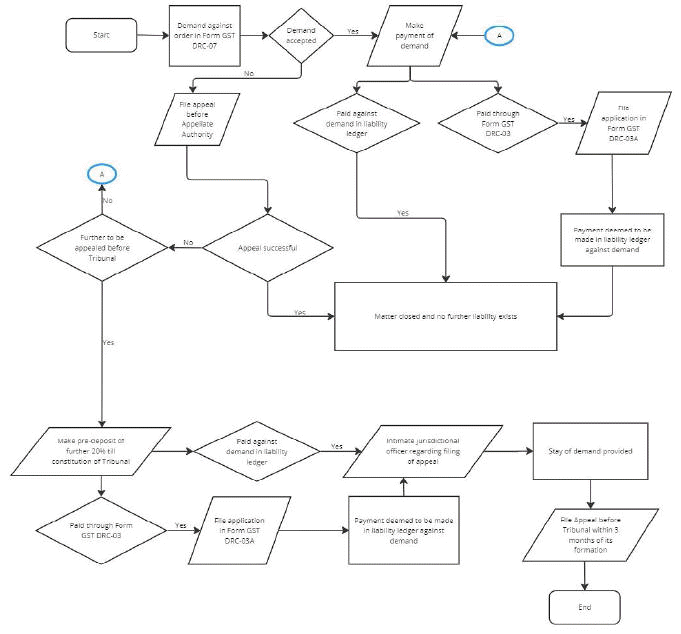
Process Summary (Flowchart)
A simplified visual flowchart illustrating the process can be inserted here for ease of understanding.